Home
Loading

aVenture is in Alpha: During this preview period, you should expect the research data to be limited and may not yet meet our exacting standards. We've made the decision to provide early access to our data to showcase the product as we build, but you should not yet rely upon it alone for your investment decisions.

aVenture is in Alpha: During this preview period, you should expect the research data to be limited and may not yet meet our exacting standards. We've made the decision to provide early access to our data to showcase the product as we build, but you should not yet rely upon it alone for your investment decisions.

Get in touch

  • Contact

  • Request a demo

  • Request data updates

  • Add a company

Research

  • Companies

  • Investors

  • People

aVenture

  • Sitemap

  • Feature requests

Member

Backed by

© aVenture Investment Company, 2026. All rights reserved.

San Francisco, CA, USA

Privacy Policy

aVenture Investment Company ("aVenture") is an independent research platform providing detailed analysis and data on startups, venture capital investments, and key industry individuals. It is not a registered investment adviser, broker-dealer, or investment advisor and does not provide investment advice or recommendations. The data provided by aVenture does not constitute recommendations or advice, whether by methodology, analysis, AI-generated content, or a statement written by a staff member of aVenture.

aVenture is not affiliated with any of the people, companies, organizations, government agencies, regulatory bodies, or investment funds we provide coverage for on this site unless explicitly stated otherwise. Users assume full responsibility for decisions made based on information obtained from this platform. Links to external websites do not imply endorsement or affiliation with aVenture. Any links that provide the ability to invest in a primary or secondary transaction in a company are for convenience only and do not constitute solicitations or offers to buy or sell an investment. Investors should exercise heightened precaution and due diligence when investing in private companies, especially those not independently audited.

While we strive to provide valuable insights with objectivity and professional diligence, we cannot guarantee the accuracy of the information provided on our platform. Before making any investment decisions, you should verify the accuracy of all pertinent details for your decision. To the fullest extent permitted by law, aVenture shall not be liable for any direct, indirect, incidental, consequential, or financial damages arising from use of this site, whether by consumers of its contents directly or by persons or organizations covered by our research, even if we are advised of the possibility. Our best-efforts processes and correction request forms do not create a warranty or duty of care.

Profiles on this platform may include content generated in part by large language models (LLMs, artificial intelligence) that aggregate publicly available sources (e.g., SEC EDGAR, public filings, press releases). Source attribution is provided where known; always verify statements and claims here against original sources before relying on any data. Content on our site may contain inaccuracies, omissions, or what are commonly called 'hallucinations' if generated in part or in full by AI / LLMs. The risk can also exist even when content is written by a human, as internal and third-party sources may also have inaccuracies for the same or different reasons. While we randomly audit a proportion of content, this is not exhaustive.

We recommend that an independent auditor be hired to verify the accuracy of the information before relying on it for any sensitive decisions. By accessing this platform, you agree not to rely solely on any information generated by AI, aggregated, or sourced or written otherwise on this site, for investment, financial, or other decisions. aVenture assumes no responsibility for inaccuracies, omissions, or hallucinations. You must independently verify all data from primary sources. Use of this platform constitutes your waiver of claims for reliance-based damages, including negligent misrepresentation. To report an error, request a correction, or dispute information about a company or individual, contact us via our request data updates form.

Loading
Loading
Home
News
Hippocratic is building a large language model for healthcare

From TechCrunch

By Kyle Wiggers

May 16, 2023

Hippocratic is building a large language model for healthcare

Hippocratic is building a large language model for healthcare

AI, specifically generative AI, has the potential to transform healthcare.

At least, that sales pitch from Hippocratic Health, which emerged from stealth today with a whopping $50 million in seed financing behind it and a valuation in the “triple digit millions.” The tranche, co-led by General Catalyst and Andreessen Horowitz, is a big vote of confidence in Hippocratic’s technology, a text-generating model tuned specifically for healthcare applications.

Hippocratic — hatched out of General Catalyst — was founded by a group of physicians, hospital administrators, Medicare professionals and AI researchers from organizations including Johns Hopkins, Stanford, Google and Nvidia. After co-founder and CEO Munjal Shah sold his previous company, Like.com, a shopping comparison site, to Google in 2010, he spent the better part of the next decade building Hippocratic.

“Hippocratic has created the first safety-focused large language model (LLM) designed specifically for healthcare,” Shah told TechCrunch in an email interview. “The company mission is to develop the safest artificial health general intelligence in order to dramatically improve healthcare accessibility and health outcomes.”

AI in healthcare, historically, has been met with mixed success.

Babylon Health, an AI startup backed by the U.K.’s National Health Service, has found itself under repeated scrutiny for making claims that its disease-diagnosing tech can perform better than doctors. IBM was forced to sell its AI-focused Watson Health divisio at a loss after technical problems led major customer partnerships to deteriorate. Elsewhere, OpenAI’s GPT-3, the predecessor to GPT-4, urged at least one user to commit suicide.

Shah emphasized that Hippocratic isn’t focused on diagnosing. Rather, he says, the tech — which is consumer-facing — is aimed at use cases like explaining benefits and billing, providing dietary advice and medication reminders, answering pre-op questions, onboarding patients and delivering “negative” test results that indicate nothing’s wrong.
Hippocratic

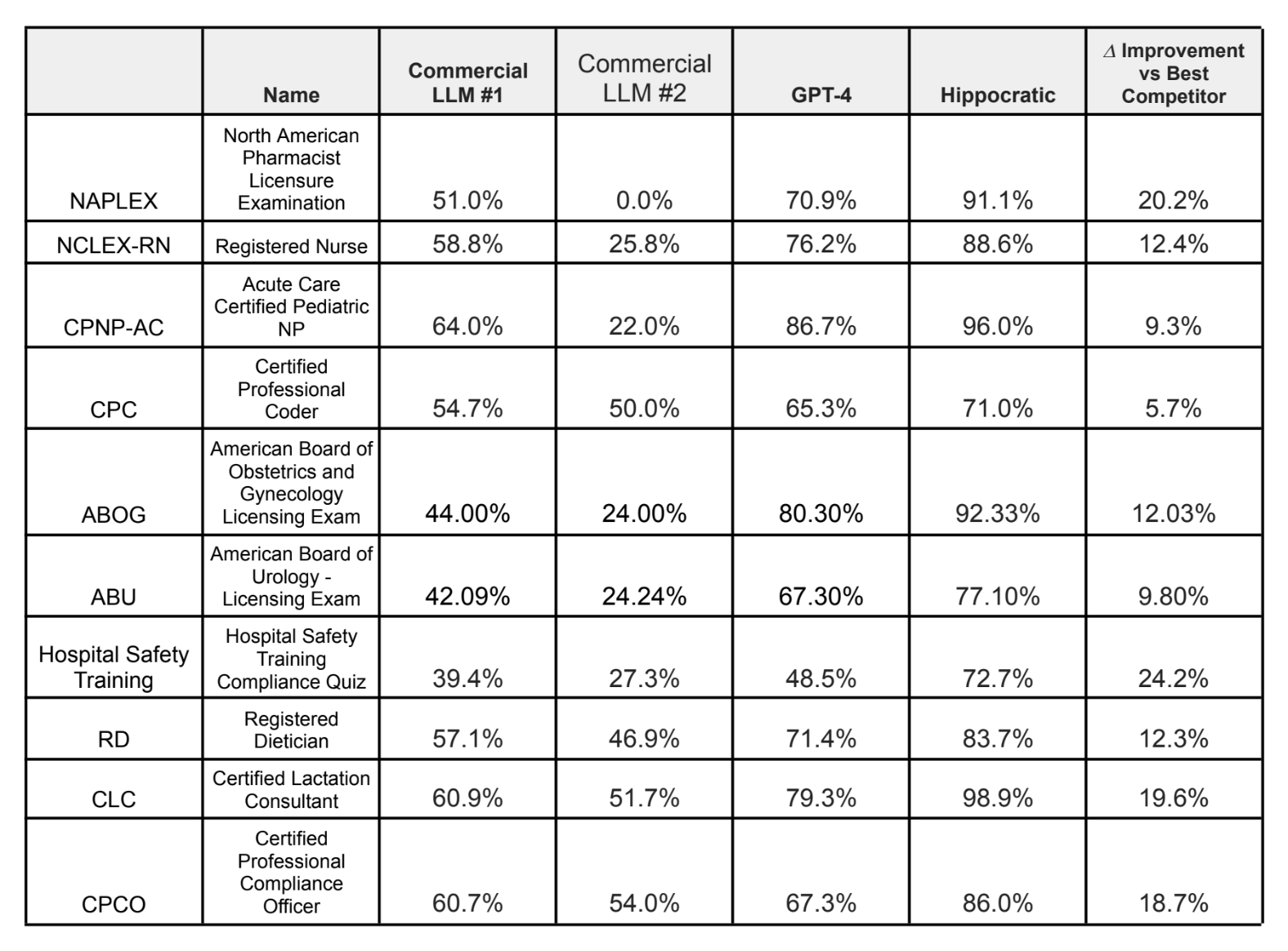
Hippocratic’s benchmark results on a range of medical exams.

The dietary advice use case gave me pause, I must say, in light of the poor diet-related suggestions AI like OpenAI’s ChatGPT provides. But Shah claims that Hippocratic’s AI outperforms leading language models including GPT-4 and Claude on over 100 healthcare certifications, including the NCLEX-RN for nursing, the American Board of Urology exam and the registered dietitian exam.

“The language models have to be safe,” Shah said. “That’s why we’re building a model just focused on safety, certifying it with healthcare professionals and partnering closely with the industry … This will help ensure that data retention and privacy policies will be consistent with the current norms of the healthcare industry.”

One of the ways Hippocratic aims to achieve this is by “detecting tone” and “communicating empathy” better than rival tech, Shah says — in part by “building in” good bedside manner (i.e. the elusive “human touch”). He makes the case that bedside manner — especially interactions that leave patients with a sense of hope, even in grim circumstances — can and do affect health outcomes.

To evaluate bedside manner, Hippocratic designed a benchmark to test the model for signs of humanism, if you will — things like “showing empathy” and “taking a personal interest in a patient’s life.” (Whether a single test can accurately capture subjects that nuanced is up for debate, of course.) Unsurprisingly given the source, Hippocratic’s model scored the highest across all categories of the models that Hippocratic tested, including GPT-4.

But can a language model really replace a healthcare worker? Hippocratic invites the question, arguing that its models were trained under the supervision of medical professionals and, thus, highly capable.

“We’re only releasing each role — dietician, billing agent, genetic counselor, etc. — once the people who actually do that role today in real life agree the model is ready,” Shah said. “In the pandemic, labor costs went up 30% for most health systems, but revenue didn’t. Hence, most health systems in the country are financially struggling. Language models can help them reduce costs by filling their current large level of vacancies in a more cost-effective way.”

I’m not sure healthcare practitioners would agree — particularly considering the Hippocratic model’s low scores on some of the aforementioned certifications. According to Hippocratic, the model got a 71% on the certified professional coder exam, which covers knowledge of medical billing and coding, and 72.7% on a hospital safety training compliance quiz.

There’s the matter of potential bias, as well. Bias plagues the healthcare industry, and these effects trickle down to the models trained on biased medical records, studies and research. A 2019 study, for instance, found that an algorithm many hospitals were using to decide which patients needed care treated Black patients with less sensitivity than white patients.

In any case, one would hope Hippocratic makes it clear that its models aren’t infallible. In domains like healthcare, automation bias, or the propensity for people to trust AI over other sources, even if they’re correct, comes with plainly high risks.

Those details are among the many that Hippocratic has yet to iron out. The company isn’t releasing details on its partners or customers, preferring instead to keep the focus on the funding. The model isn’t even available at present — nor information about what data it was trained on, or what data it might be trained on in the future. (Hippocratic would only say that it’ll use “de-identified” data for the model training.)

If it waits too long, Hippocratic runs the risk of falling behind rivals like Truveta and Latent — some of which have a major resource advantage. For example, Google recently began previewing Med-PaLM 2, which it claims was the first language model to perform at an expert level on dozens of medical exam questions. Like Hippocratic’s model, Med-PaLM 2 was evaluated by health professionals on its ability to answer medical questions accurately — and safely.

But Hemant Taneja, the managing director at General Catalyst, didn’t express concern.

“Munjal and I hatched this company on the belief that healthcare needs its own language model built specifically for healthcare applications — one that is fair, unbiased, secure and beneficial to society,” he said via email. “We set forth to create a high-integrity AI application that is fed a ‘healthy’ data diet and includes a training approach that seeks to incorporate extensive human feedback from medical experts for each specialized task. In healthcare, we simply can’t afford to ‘move fast and break things.'”

Shah says that the bulk of the $50 million seed tranche will be put toward investing in talent, compute data and partnerships.

Hippocratic is building a large language model for healthcare by Kyle Wiggers originally published on TechCrunch

Most Recent

Neil Rimer thinks the AI money is coming back out

Neil Rimer thinks the AI money is coming back out

Neil Rimer, the venture capitalist who co-founded Index Ventures, predicts the historic wealth AI is generating in Silicon Valley will have to be redistributed, voluntarily or involuntarily.

Jul 17, 2026

Databricks hits $188B valuation, extending its run as AI’s favorite second act

Databricks hits $188B valuation, extending its run as AI’s favorite second act

Databricks has remade its image into an AI company and has published research on the cost savings of open weight AI models for coding.

Jul 17, 2026

Nuclear startup Valar Atomics in talks to raise new funding at $6B valuation

Nuclear startup Valar Atomics in talks to raise new funding at $6B valuation

The potential deal highlights a growing trend of complex, multi-stage funding rounds that mask true entry prices.

Jul 17, 2026

Founders Fund hires former OpenAI exec Ryan Beiermeister (and not because of her ‘Mafia’ skills)

Founders Fund hires former OpenAI exec Ryan Beiermeister (and not because of her ‘Mafia’ skills)

Ryan Beiermeister, who demonstrated cool analysis in the Founders Fund YouTube series "Mafia," has joined the firm as a partner.

Jul 16, 2026

Similar Posts

Innovaccer aims to become healthcare’s AI powerhouse with $275M Series F

Innovaccer aims to become healthcare’s AI powerhouse with $275M Series F

When it comes to data, perhaps no sector has as much of it and in as many distinct silos as the healthcare industry. Hundreds of millions of patient records reside within various electronic health records (EHRs) maintained by vendors like Epic, Cerner and Athena. Insurance companies hold extensive data sets on coverage, reimbursement rates, and patient demographics. Pharmacies and laboratories contribute further data points on medication usage and diagnostic results. Over the last decade or so

Jan 9, 2025

Fixie wants to make it easier for companies to build on top of language models

Fixie wants to make it easier for companies to build on top of language models

Yet another startup hoping to cash in on the generative AI craze has secured an eye-popping tranche of VC funding. Called Fixie, the firm, founded by former engineering heads at Apple and Google, aims to connect text-generating models similar to OpenAI’s ChatGPT to an enterprise’s data, systems and workflows. Co-founder and CEO Matt Welsh describes […]

Mar 30, 2023

Hippocratic AI raises $141M for creating patient-facing AI agents

Hippocratic AI raises $141M for creating patient-facing AI agents

Hippocratic AI, a startup building AI solutions that can handle non-diagnostic patient-facing tasks, secured a massive $141 million Series B at a valuation of $1.64 billion led by Kleiner Perkins, the company announced Thursday. The funding comes nine months after Hippocratic AI raised a $53 million round from General Catalyst and Andreessen Horowitz and five months after raising $17 million from Nvidia. The startup is less than two years old. While most healthcare-generative AI companies focus

Jan 9, 2025

Lotus Health nabs $35M for AI doctor that sees patients for free

Lotus Health nabs $35M for AI doctor that sees patients for free

This AI doctor is licensed in all 50 states, the startup says. The deal was led by CRV and Kleiner Perkins.

Feb 3, 2026

Most Recent

Neil Rimer thinks the AI money is coming back out

Neil Rimer thinks the AI money is coming back out

Neil Rimer, the venture capitalist who co-founded Index Ventures, predicts the historic wealth AI is generating in Silicon Valley will have to be redistributed, voluntarily or involuntarily.

Jul 17, 2026

Databricks hits $188B valuation, extending its run as AI’s favorite second act

Databricks hits $188B valuation, extending its run as AI’s favorite second act

Databricks has remade its image into an AI company and has published research on the cost savings of open weight AI models for coding.

Jul 17, 2026

Nuclear startup Valar Atomics in talks to raise new funding at $6B valuation

Nuclear startup Valar Atomics in talks to raise new funding at $6B valuation

The potential deal highlights a growing trend of complex, multi-stage funding rounds that mask true entry prices.

Jul 17, 2026

Founders Fund hires former OpenAI exec Ryan Beiermeister (and not because of her ‘Mafia’ skills)

Founders Fund hires former OpenAI exec Ryan Beiermeister (and not because of her ‘Mafia’ skills)

Ryan Beiermeister, who demonstrated cool analysis in the Founders Fund YouTube series "Mafia," has joined the firm as a partner.

Jul 16, 2026

Similar Posts

Innovaccer aims to become healthcare’s AI powerhouse with $275M Series F

Innovaccer aims to become healthcare’s AI powerhouse with $275M Series F

When it comes to data, perhaps no sector has as much of it and in as many distinct silos as the healthcare industry. Hundreds of millions of patient records reside within various electronic health records (EHRs) maintained by vendors like Epic, Cerner and Athena. Insurance companies hold extensive data sets on coverage, reimbursement rates, and patient demographics. Pharmacies and laboratories contribute further data points on medication usage and diagnostic results. Over the last decade or so

Jan 9, 2025

Fixie wants to make it easier for companies to build on top of language models

Fixie wants to make it easier for companies to build on top of language models

Yet another startup hoping to cash in on the generative AI craze has secured an eye-popping tranche of VC funding. Called Fixie, the firm, founded by former engineering heads at Apple and Google, aims to connect text-generating models similar to OpenAI’s ChatGPT to an enterprise’s data, systems and workflows. Co-founder and CEO Matt Welsh describes […]

Mar 30, 2023

Hippocratic AI raises $141M for creating patient-facing AI agents

Hippocratic AI raises $141M for creating patient-facing AI agents

Hippocratic AI, a startup building AI solutions that can handle non-diagnostic patient-facing tasks, secured a massive $141 million Series B at a valuation of $1.64 billion led by Kleiner Perkins, the company announced Thursday. The funding comes nine months after Hippocratic AI raised a $53 million round from General Catalyst and Andreessen Horowitz and five months after raising $17 million from Nvidia. The startup is less than two years old. While most healthcare-generative AI companies focus

Jan 9, 2025

Lotus Health nabs $35M for AI doctor that sees patients for free

Lotus Health nabs $35M for AI doctor that sees patients for free

This AI doctor is licensed in all 50 states, the startup says. The deal was led by CRV and Kleiner Perkins.

Feb 3, 2026