Home
Loading

aVenture is in Alpha: During this preview period, you should expect the research data to be limited and may not yet meet our exacting standards. We've made the decision to provide early access to our data to showcase the product as we build, but you should not yet rely upon it alone for your investment decisions.

aVenture is in Alpha: During this preview period, you should expect the research data to be limited and may not yet meet our exacting standards. We've made the decision to provide early access to our data to showcase the product as we build, but you should not yet rely upon it alone for your investment decisions.

Get in touch

  • Contact

  • Request a demo

  • Request data updates

  • Add a company

Research

  • Companies

  • Investors

  • People

aVenture

  • Sitemap

  • Feature requests

Member

Backed by

© aVenture Investment Company, 2026. All rights reserved.

San Francisco, CA, USA

Privacy Policy

aVenture Investment Company ("aVenture") is an independent research platform providing detailed analysis and data on startups, venture capital investments, and key industry individuals. It is not a registered investment adviser, broker-dealer, or investment advisor and does not provide investment advice or recommendations. The data provided by aVenture does not constitute recommendations or advice, whether by methodology, analysis, AI-generated content, or a statement written by a staff member of aVenture.

aVenture is not affiliated with any of the people, companies, organizations, government agencies, regulatory bodies, or investment funds we provide coverage for on this site unless explicitly stated otherwise. Users assume full responsibility for decisions made based on information obtained from this platform. Links to external websites do not imply endorsement or affiliation with aVenture. Any links that provide the ability to invest in a primary or secondary transaction in a company are for convenience only and do not constitute solicitations or offers to buy or sell an investment. Investors should exercise heightened precaution and due diligence when investing in private companies, especially those not independently audited.

While we strive to provide valuable insights with objectivity and professional diligence, we cannot guarantee the accuracy of the information provided on our platform. Before making any investment decisions, you should verify the accuracy of all pertinent details for your decision. To the fullest extent permitted by law, aVenture shall not be liable for any direct, indirect, incidental, consequential, or financial damages arising from use of this site, whether by consumers of its contents directly or by persons or organizations covered by our research, even if we are advised of the possibility. Our best-efforts processes and correction request forms do not create a warranty or duty of care.

Profiles on this platform may include content generated in part by large language models (LLMs, artificial intelligence) that aggregate publicly available sources (e.g., SEC EDGAR, public filings, press releases). Source attribution is provided where known; always verify statements and claims here against original sources before relying on any data. Content on our site may contain inaccuracies, omissions, or what are commonly called 'hallucinations' if generated in part or in full by AI / LLMs. The risk can also exist even when content is written by a human, as internal and third-party sources may also have inaccuracies for the same or different reasons. While we randomly audit a proportion of content, this is not exhaustive.

We recommend that an independent auditor be hired to verify the accuracy of the information before relying on it for any sensitive decisions. By accessing this platform, you agree not to rely solely on any information generated by AI, aggregated, or sourced or written otherwise on this site, for investment, financial, or other decisions. aVenture assumes no responsibility for inaccuracies, omissions, or hallucinations. You must independently verify all data from primary sources. Use of this platform constitutes your waiver of claims for reliance-based damages, including negligent misrepresentation. To report an error, request a correction, or dispute information about a company or individual, contact us via our request data updates form.

Loading
Loading
Home
News
OpenAI’s new tool attempts to explain language models’ behaviors

From TechCrunch

By Kyle Wiggers

May 9, 2023

OpenAI’s new tool attempts to explain language models’ behaviors

OpenAI’s new tool attempts to explain language models’ behaviors

It’s often said that large language models (LLMs) along the lines of OpenAI’s ChatGPT are a black box, and certainly, there’s some truth to that. Even for data scientists, it’s difficult to know why, always, a model responds in the way it does, like  inventing facts out of whole cloth.

In an effort to peel back the layers of LLMs, OpenAI is developing a tool to automatically identify which parts of an LLM are responsible for which of its behaviors. The engineers behind it stress that it’s in the early stages, but the code to run it is available in open source on GitHub as of this morning.

“We’re trying to [develop ways to] anticipate what the problems with an AI system will be,” William Saunders, the interpretability team manager at OpenAI, told TechCrunch in a phone interview. “We want to really be able to know that we can trust what the model is doing and the answer that it produces.”

To that end, OpenAI’s tool uses a language model (ironically) to figure out the functions of the components of other, architecturally simpler LLMs — specifically OpenAI’s own GPT-2.
OpenAI explainability

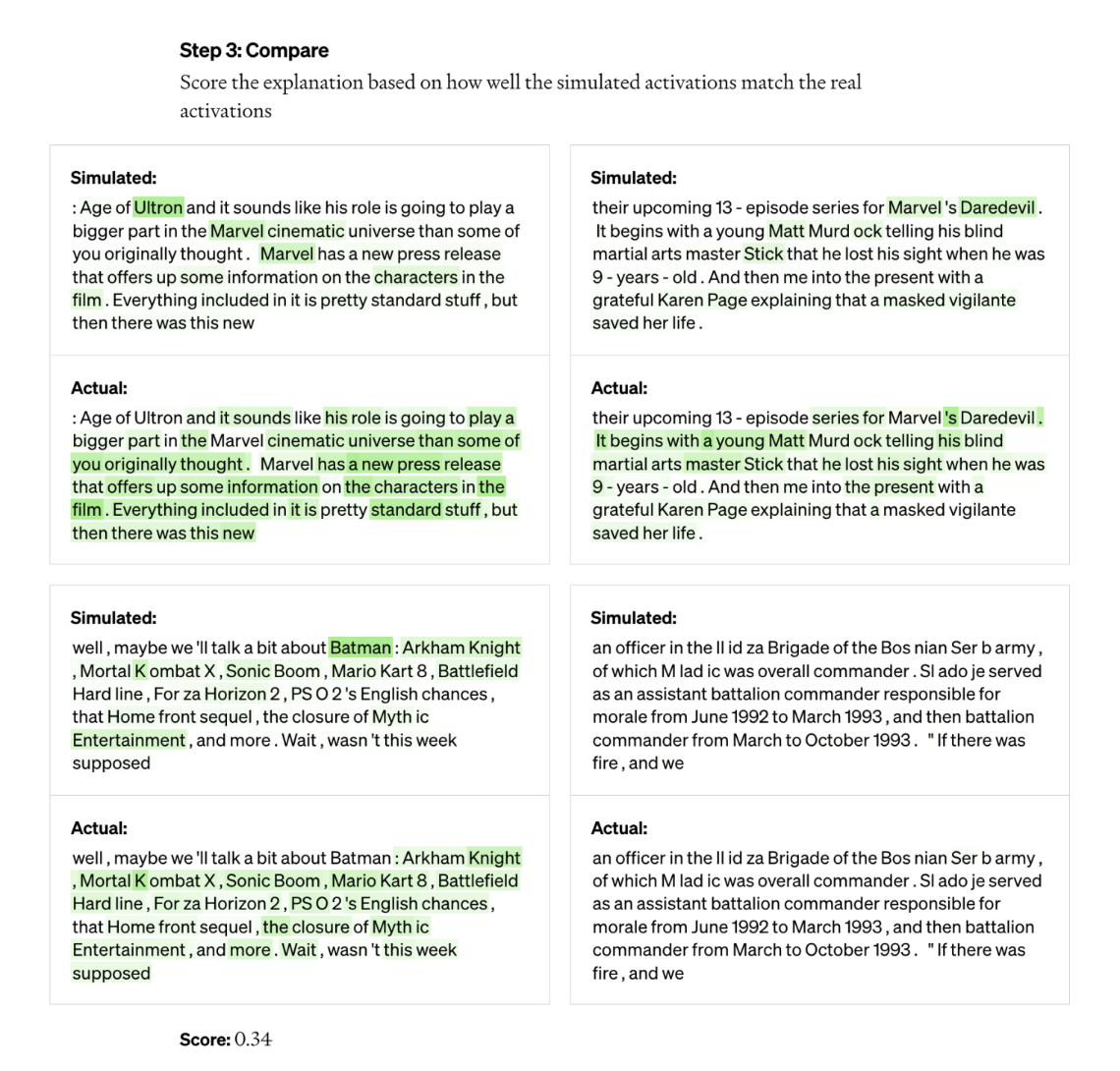
OpenAI’s tool attempts to simulate the behaviors of neurons in an LLM.

How? First, a quick explainer on LLMs for background. Like the brain, they’re made up of “neurons,” which observe some specific pattern in text to influence what the overall model “says” next. For example, given a prompt about superheros (e.g. “Which superheros have the most useful superpowers?”), a “Marvel superhero neuron” might boost the probability the model names specific superheroes from Marvel movies.

OpenAI’s tool exploits this setup to break models down into their individual pieces. First, the tool runs text sequences through the model being evaluated and waits for cases where a particular neuron “activates” frequently. Next, it “shows” GPT-4, OpenAI’s latest text-generating AI model, these highly active neurons and has GPT-4 generate an explanation. To determine how accurate the explanation is, the tool provides GPT-4 with text sequences and has it predict, or simulate, how the neuron would behave. In then compares the behavior of the simulated neuron with the behavior of the actual neuron.

“Using this methodology, we can basically, for every single neuron, come up with some kind of preliminary natural language explanation for what it’s doing and also have a score for how how well that explanation matches the actual behavior,” Jeff Wu, who leads the scalable alignment team at OpenAI, said. “We’re using GPT-4 as part of the process to produce explanations of what a neuron is looking for and then score how well those explanations match the reality of what it’s doing.”

The researchers were able to generate explanations for all 307,200 neurons in GPT-2, which they compiled in a data set that’s been released alongside the tool code.

Tools like this could one day be used to improve an LLM’s performance, the researchers say — for example to cut down on bias or toxicity. But they acknowledge that it has a long way to go before it’s genuinely useful. The tool was confident in its explanations for about 1,000 of those neurons, a small fraction of the total.

A cynical person might argue, too, that the tool is essentially an advertisement for GPT-4, given that it requires GPT-4 to work. Other LLM interpretability tools are less dependent on commercial APIs, like DeepMind’s Tracr, a compiler that translates programs into neural network models.

Wu said that isn’t the case — the fact the tool uses GPT-4 is merely “incidental” — and, on the contrary, shows GPT-4’s weaknesses in this area. He also said it wasn’t created with commercial applications in mind and, in theory, could be adapted to use LLMs besides GPT-4.
OpenAI explainability

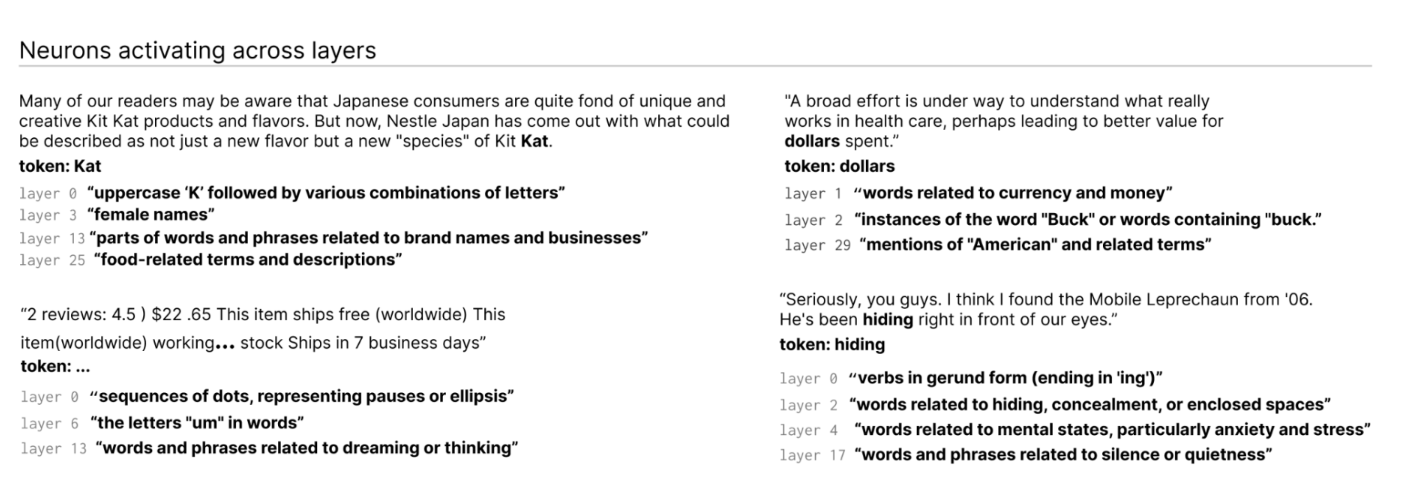
The tool identifies neurons activating across layers in the LLM.

“Most of the explanations score quite poorly  or don’t explain that much of the behavior of the actual neuron,” Wu said. “A lot of the neurons, for example, active in a way where it’s very hard to tell what’s going on — like they activate on five or six different things, but there’s no discernible pattern. Sometimes there is a discernible pattern, but GPT-4 is unable to find it.”

That’s to say nothing of more complex, newer and larger models, or models that can browse the web for information. But on that second point, Wu believes that web browsing wouldn’t change the tool’s underlying mechanisms much. It could simply be tweaked, he says, to figure out why neurons decide to make certain search engine queries or access particular websites.

“We hope that this will open up a promising avenue to address interpretability in an automated way that others can build on and contribute to,” Wu said. “The hope is that we really actually have good explanations of not just not just what neurons are responding to but overall, the behavior of these models — what kinds of circuits they’re computing and how certain neurons affect other neurons.”

OpenAI’s new tool attempts to explain language models’ behaviors by Kyle Wiggers originally published on TechCrunch

Most Recent

Neil Rimer thinks the AI money is coming back out

Neil Rimer thinks the AI money is coming back out

Neil Rimer, the venture capitalist who co-founded Index Ventures, predicts the historic wealth AI is generating in Silicon Valley will have to be redistributed, voluntarily or involuntarily.

Jul 17, 2026

Databricks hits $188B valuation, extending its run as AI’s favorite second act

Databricks hits $188B valuation, extending its run as AI’s favorite second act

Databricks has remade its image into an AI company and has published research on the cost savings of open weight AI models for coding.

Jul 17, 2026

Nuclear startup Valar Atomics in talks to raise new funding at $6B valuation

Nuclear startup Valar Atomics in talks to raise new funding at $6B valuation

The potential deal highlights a growing trend of complex, multi-stage funding rounds that mask true entry prices.

Jul 17, 2026

Founders Fund hires former OpenAI exec Ryan Beiermeister (and not because of her ‘Mafia’ skills)

Founders Fund hires former OpenAI exec Ryan Beiermeister (and not because of her ‘Mafia’ skills)

Ryan Beiermeister, who demonstrated cool analysis in the Founders Fund YouTube series "Mafia," has joined the firm as a partner.

Jul 16, 2026

Similar Posts

Stability AI releases ChatGPT-like language models

Stability AI releases ChatGPT-like language models

Stability AI, the startup behind the generative AI art tool Stable Diffusion, today open sourced a suite of text-generating AI models intended to go head to head with systems like OpenAI’s GPT-4. Called StableLM and available in “alpha” on GitHub and Hugging Face, a platform for hosting AI models and code, Stability AI says that […]

Apr 19, 2023

Reka emerges from stealth to build custom AI models for the enterprise

Reka emerges from stealth to build custom AI models for the enterprise

Large language models (LLMs) like OpenAI’s GPT-4 are all the rage these days, owing to their unparalleled ability to analyze and generate text. But for organizations looking to leverage LLMs for specific tasks — say, writing ad copy in a brand’s style — their generalist nature can become a liability. When the instructions get too […]

Jun 27, 2023

Fixie wants to make it easier for companies to build on top of language models

Fixie wants to make it easier for companies to build on top of language models

Yet another startup hoping to cash in on the generative AI craze has secured an eye-popping tranche of VC funding. Called Fixie, the firm, founded by former engineering heads at Apple and Google, aims to connect text-generating models similar to OpenAI’s ChatGPT to an enterprise’s data, systems and workflows. Co-founder and CEO Matt Welsh describes […]

Mar 30, 2023

Dust uses large language models on internal data to improve team productivity

Dust uses large language models on internal data to improve team productivity

Dust is a new AI startup based in France that is working on improving team productivity by breaking down internal silos, surfacing important knowledge and providing tools to build custom internal apps. At its core, Dust is using large language models (LLMs) on internal company data to give new super powers to team members. Co-founded […]

Jun 27, 2023

Most Recent

Neil Rimer thinks the AI money is coming back out

Neil Rimer thinks the AI money is coming back out

Neil Rimer, the venture capitalist who co-founded Index Ventures, predicts the historic wealth AI is generating in Silicon Valley will have to be redistributed, voluntarily or involuntarily.

Jul 17, 2026

Databricks hits $188B valuation, extending its run as AI’s favorite second act

Databricks hits $188B valuation, extending its run as AI’s favorite second act

Databricks has remade its image into an AI company and has published research on the cost savings of open weight AI models for coding.

Jul 17, 2026

Nuclear startup Valar Atomics in talks to raise new funding at $6B valuation

Nuclear startup Valar Atomics in talks to raise new funding at $6B valuation

The potential deal highlights a growing trend of complex, multi-stage funding rounds that mask true entry prices.

Jul 17, 2026

Founders Fund hires former OpenAI exec Ryan Beiermeister (and not because of her ‘Mafia’ skills)

Founders Fund hires former OpenAI exec Ryan Beiermeister (and not because of her ‘Mafia’ skills)

Ryan Beiermeister, who demonstrated cool analysis in the Founders Fund YouTube series "Mafia," has joined the firm as a partner.

Jul 16, 2026

Similar Posts

Stability AI releases ChatGPT-like language models

Stability AI releases ChatGPT-like language models

Stability AI, the startup behind the generative AI art tool Stable Diffusion, today open sourced a suite of text-generating AI models intended to go head to head with systems like OpenAI’s GPT-4. Called StableLM and available in “alpha” on GitHub and Hugging Face, a platform for hosting AI models and code, Stability AI says that […]

Apr 19, 2023

Reka emerges from stealth to build custom AI models for the enterprise

Reka emerges from stealth to build custom AI models for the enterprise

Large language models (LLMs) like OpenAI’s GPT-4 are all the rage these days, owing to their unparalleled ability to analyze and generate text. But for organizations looking to leverage LLMs for specific tasks — say, writing ad copy in a brand’s style — their generalist nature can become a liability. When the instructions get too […]

Jun 27, 2023

Fixie wants to make it easier for companies to build on top of language models

Fixie wants to make it easier for companies to build on top of language models

Yet another startup hoping to cash in on the generative AI craze has secured an eye-popping tranche of VC funding. Called Fixie, the firm, founded by former engineering heads at Apple and Google, aims to connect text-generating models similar to OpenAI’s ChatGPT to an enterprise’s data, systems and workflows. Co-founder and CEO Matt Welsh describes […]

Mar 30, 2023

Dust uses large language models on internal data to improve team productivity

Dust uses large language models on internal data to improve team productivity

Dust is a new AI startup based in France that is working on improving team productivity by breaking down internal silos, surfacing important knowledge and providing tools to build custom internal apps. At its core, Dust is using large language models (LLMs) on internal company data to give new super powers to team members. Co-founded […]

Jun 27, 2023