Home
Loading

aVenture is in Alpha: During this preview period, you should expect the research data to be limited and may not yet meet our exacting standards. We've made the decision to provide early access to our data to showcase the product as we build, but you should not yet rely upon it alone for your investment decisions.

aVenture is in Alpha: During this preview period, you should expect the research data to be limited and may not yet meet our exacting standards. We've made the decision to provide early access to our data to showcase the product as we build, but you should not yet rely upon it alone for your investment decisions.

Get in touch

  • Contact

  • Request a demo

  • Request data updates

  • Add a company

Research

  • Companies

  • Investors

  • People

aVenture

  • Sitemap

  • Feature requests

Member

Backed by

© aVenture Investment Company, 2026. All rights reserved.

San Francisco, CA, USA

Privacy Policy

aVenture Investment Company ("aVenture") is an independent research platform providing detailed analysis and data on startups, venture capital investments, and key industry individuals. It is not a registered investment adviser, broker-dealer, or investment advisor and does not provide investment advice or recommendations. The data provided by aVenture does not constitute recommendations or advice, whether by methodology, analysis, AI-generated content, or a statement written by a staff member of aVenture.

aVenture is not affiliated with any of the people, companies, organizations, government agencies, regulatory bodies, or investment funds we provide coverage for on this site unless explicitly stated otherwise. Users assume full responsibility for decisions made based on information obtained from this platform. Links to external websites do not imply endorsement or affiliation with aVenture. Any links that provide the ability to invest in a primary or secondary transaction in a company are for convenience only and do not constitute solicitations or offers to buy or sell an investment. Investors should exercise heightened precaution and due diligence when investing in private companies, especially those not independently audited.

While we strive to provide valuable insights with objectivity and professional diligence, we cannot guarantee the accuracy of the information provided on our platform. Before making any investment decisions, you should verify the accuracy of all pertinent details for your decision. To the fullest extent permitted by law, aVenture shall not be liable for any direct, indirect, incidental, consequential, or financial damages arising from use of this site, whether by consumers of its contents directly or by persons or organizations covered by our research, even if we are advised of the possibility. Our best-efforts processes and correction request forms do not create a warranty or duty of care.

Profiles on this platform may include content generated in part by large language models (LLMs, artificial intelligence) that aggregate publicly available sources (e.g., SEC EDGAR, public filings, press releases). Source attribution is provided where known; always verify statements and claims here against original sources before relying on any data. Content on our site may contain inaccuracies, omissions, or what are commonly called 'hallucinations' if generated in part or in full by AI / LLMs. The risk can also exist even when content is written by a human, as internal and third-party sources may also have inaccuracies for the same or different reasons. While we randomly audit a proportion of content, this is not exhaustive.

We recommend that an independent auditor be hired to verify the accuracy of the information before relying on it for any sensitive decisions. By accessing this platform, you agree not to rely solely on any information generated by AI, aggregated, or sourced or written otherwise on this site, for investment, financial, or other decisions. aVenture assumes no responsibility for inaccuracies, omissions, or hallucinations. You must independently verify all data from primary sources. Use of this platform constitutes your waiver of claims for reliance-based damages, including negligent misrepresentation. To report an error, request a correction, or dispute information about a company or individual, contact us via our request data updates form.

Loading
Loading
Home
News
This startup wants to train art-generating AI strictly on licensed images

From TechCrunch

By Kyle Wiggers

April 13, 2023

This startup wants to train art-generating AI strictly on licensed images

This startup wants to train art-generating AI strictly on licensed images

Generative AI, particularly text-to-image AI, is attracting as many lawsuits as it is venture dollars.

Two companies behind popular AI art tools, Midjourney and Stability AI, are entangled in a legal case that alleges they infringed on the rights of millions of artists by training their tools on web-scraped images. Separately, stock image supplier Getty Images took Stability AI to court for reportedly using images from its site without permission to train Stable Diffusio , an art-generating AI.

Generative AI’s flaws — a tendency to regurgitate the data it’s trained on and, relatedly, the makeup of its training data — continues to put it in the legal crosshairs. But a new startup, Bria, claims to minimize the risk by training image-generating — and soon video-generating — AI in an “ethical” way.

“Our goal is to empower both developers and creators while ensuring that our platform is legally and ethically sound,” Yair Adato, the co-founder of Bria, told TechCrunch in an email interview. “We combined the best of visual generative AI technology and responsible AI practices to create a sustainable model that prioritizes these considerations.”
Bria

Image Credits: Bria

Adato co-founded Bria when the pandemic hit in 2020, and the company’s other co-founder, Assa Eldar, joined in 2022. During Adato’s Ph.D. studies in computer science at Ben-Gurion University of the Negev, he says he developed a passion for computer vision and its potential to “improve” communication through generative AI.

“I realized that there’s a real business use case for this,” Adato said. “The process of creating visuals is complex, manual and often requires specialized skills. Bria was created to address this challenge — providing a visual generative AI platform tailored to enterprises that digitizes and automates this entire process.”

Thanks to recent advancements in the field of AI, both on the commercial and research side (open source models, the decreasing cost of compute, and so on), there’s no shortage of platforms that offer text-to-image AI art tools (Midjourney, DeviantArt, etc.). But Adato claims that Bria’s different in that it (1) focuses exclusively on the enterprise and (2) was built from the start with ethical considerations in mind.

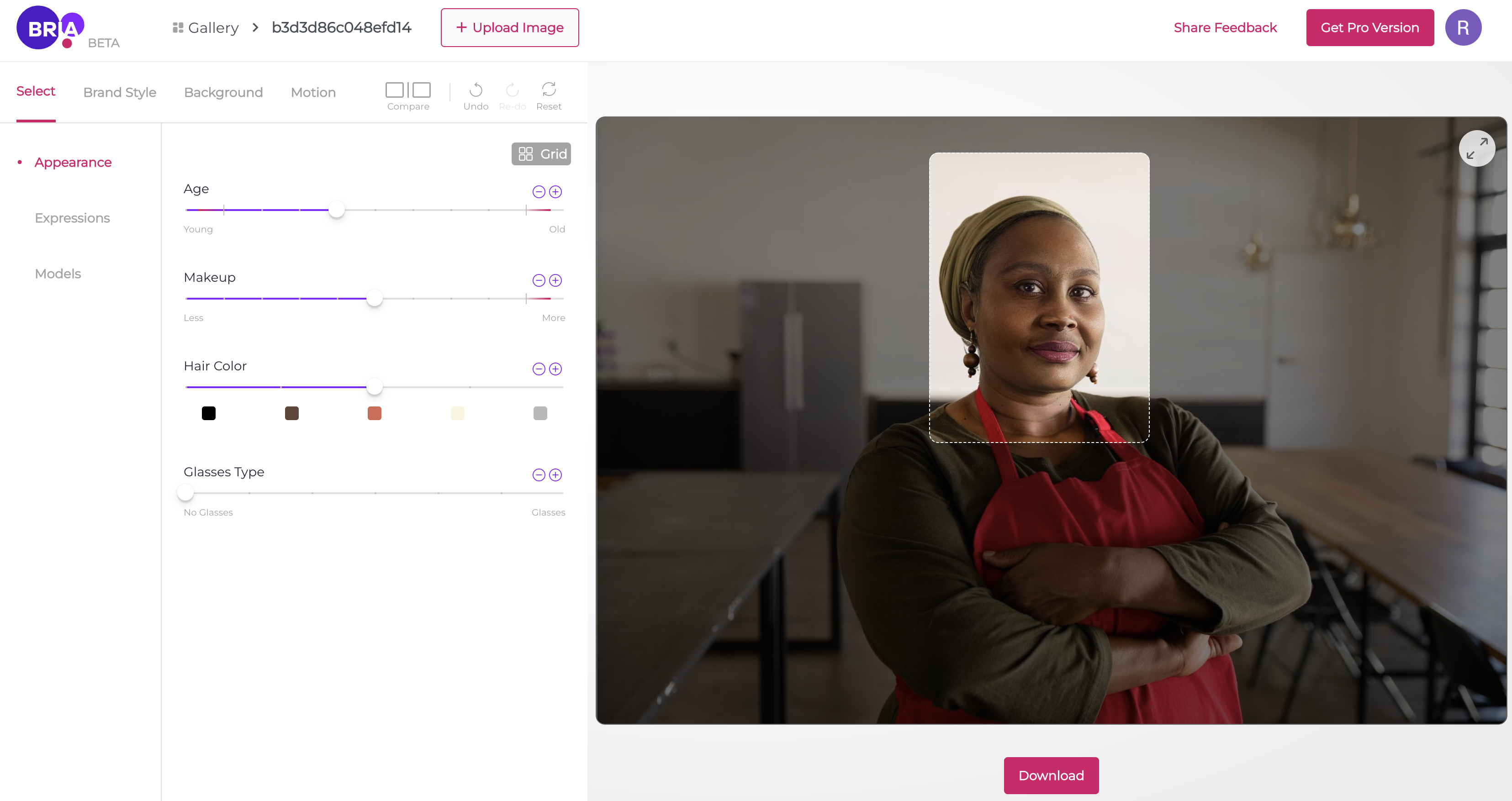
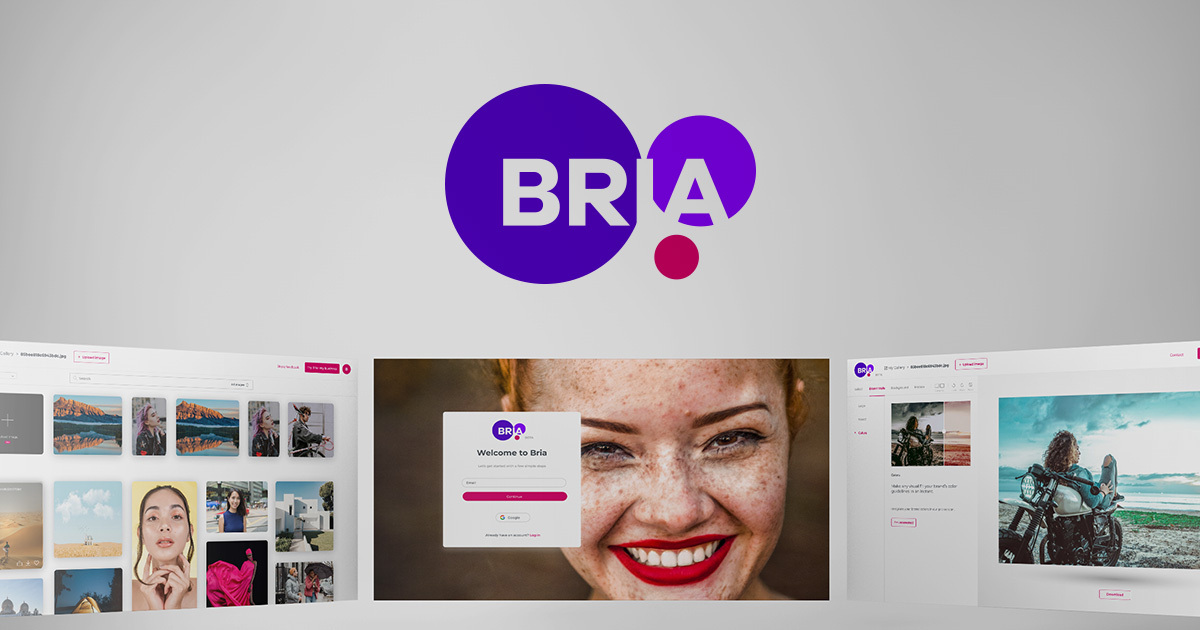
Bria’s platform enables businesses to create visuals for social media posts, ads and e-commerce listings using its image-generating AI. Via a web app (an API is on the way) and Nvidia’s Picasso cloud AI service, customers can generate, modify or upload visuals and optionally switch on a “brand guardian” feature, which attempts to ensure their visuals follow brand guidelines.

The AI in question is trained on “authorized” datasets containing content that Bria licenses from partners, including individual photographers and artists, as well as media companies and stock image repositories, which receive a portion of the startup’s revenue.

Bria isn’t the only venture exploring a revenue-sharing business model for generative AI. Shutterstock’s recently launched Contributors Fund reimburses creators whose work is used to train AI art models, while OpenAI licensed a portion of Shutterstock’s library to train DALL-E 2, its image generation tool. Adobe, meanwhile, says that it’s developing a compensation model for contributors to Adobe Stock, its stock content library, that’ll allow them to “monetize their talents” and benefit from any revenue its generative AI technology, Firefly, brings in.

But Bria’s approach is more extensive, Adato tells me. The company’s revenue share model rewards data owners based on their contributions’ impact, allowing artists to set prices on a per-AI-training-run basis.

Adato explains: “Every time an image is generated using Bria’s generative platform, we trace back the visuals in the training set that contributed the most to the [generated art], and we use our technology to allocate revenue among the creators. This approach allows us to have multiple licensed sources in our training set, including artists, and avoid any issues related to copyright infringement.”
Bria

Image Credits: Bria

Bria also clearly denotes all generated images on its platform with a watermark and provides free access — or so it claims, at least — to nonprofits and academics who “work to democratize creativity, prevent deepfakes or promote diversity.”

In the coming months, Bria plans to go a step further, offering an open source generative AI art model with a built-in attribution mechanism. There’s been attempts at this, like Have I Been Trained? and Stable Attributio , sites that make a best effort to identify which art pieces contributed to a particular AI-generated visual. But Bria’s model will allow other generative platforms to establish similar revenue sharing arrangements with creators, Adato says.

It’s tough to put too much stock into Bria’s tech given the nascency of the generative AI industry. It’s unclear how, for example, Bria is “tracing back” visuals in the training sets and using this data to portion out revenue. How will Bria resolve complaints from creators who allege they’re being unfairly underpaid? Will bugs in the system result in some creators being overpaid? Time will tell.

Adato exudes the confidence you’d expect from a founder despite the unknowns, arguing Bria’s platform ensures each contributor to the AI training datasets gets their fair share based on usage and “real impact.”

“We believe that the most effective way to solve [the challenges around generative AI] is at the training set level, by using a high-quality, enterprise-grade, balanced and safe training set,” Adato said. “When it comes to adopting generative AI, companies need to consider the ethical and legal implications to ensure that the technology is used in a responsible and safe manner. However, by working with Bria, companies can rest assured that these concerns are taken care of.”

That’s an open question. And it’s not the only one.

What if a creator wants to opt out of Bria’s platform? Can they? Adato assures me that they’ll be able to. But Bria uses its own opt-out mechanism as opposed to a common standard such as DeviantArt‘s or artist advocacy group Spawning‘s, which offers a website where artists can remove their art from one of the more popular generative art training data sets.

That raises the burden for content creators, who now have to potentially worry about taking the steps to remove their art from yet another generative AI platform (unless of course they use a “cloaking” tool such as Glaze, rendering their art untrainable). Adato doesn’t see it that way.

“We’ve made it a priority to focus on safe and quality enterprise data collections in the construction of our training sets to avoid biased or toxic data and copyright infringement,” he said. “Overall, our commitment to ethical and responsible training of AI models sets us apart from our competitors.”

Those competitors include incumbents like OpenAI, Midjourney and Stability AI, as well as Jasper, whose generative art tool, Jasper Art, also targets enterprise customers. The formidable competition — and open ethical questions — doesn’t seem to have scared away investors, though — Bria has raised $10 million in venture capital to date from Entrée Capital, IN Venture, Getty Images and a group of Israeli angel investors.

Bria

Image Credits: Bria

Adato said that Bria is currently serving “a range” of clients, including marketing agencies, visual stock repositories and tech and marketing firms. “We’re committed to continuing to grow our customer base and provide them with innovative solutions for their visual communication needs,” he added.

Should Bria succeed, part of me wonders if it’ll spawn a new crop of generative AI companies more limited in scope than the big players today — and thus less susceptible to legal challenges. With funding for generative AI starting to cool off, partly because of the high level of competition and questions around liability, more “narrow” generative AI startups just might stand a chance at cutting through the noise — and avoiding lawsuits in the process.

We’ll have to wait and see.

This startup wants to train art-generating AI strictly on licensed images by Kyle Wiggers originally published on TechCrunch

Most Recent

Neil Rimer thinks the AI money is coming back out

Neil Rimer thinks the AI money is coming back out

Neil Rimer, the venture capitalist who co-founded Index Ventures, predicts the historic wealth AI is generating in Silicon Valley will have to be redistributed, voluntarily or involuntarily.

Jul 17, 2026

Databricks hits $188B valuation, extending its run as AI’s favorite second act

Databricks hits $188B valuation, extending its run as AI’s favorite second act

Databricks has remade its image into an AI company and has published research on the cost savings of open weight AI models for coding.

Jul 17, 2026

Nuclear startup Valar Atomics in talks to raise new funding at $6B valuation

Nuclear startup Valar Atomics in talks to raise new funding at $6B valuation

The potential deal highlights a growing trend of complex, multi-stage funding rounds that mask true entry prices.

Jul 17, 2026

Founders Fund hires former OpenAI exec Ryan Beiermeister (and not because of her ‘Mafia’ skills)

Founders Fund hires former OpenAI exec Ryan Beiermeister (and not because of her ‘Mafia’ skills)

Ryan Beiermeister, who demonstrated cool analysis in the Founders Fund YouTube series "Mafia," has joined the firm as a partner.

Jul 16, 2026

Similar Posts

Spawning lays out plans for letting creators opt out of generative AI training

Spawning lays out plans for letting creators opt out of generative AI training

The legal spats between artists and the companies training AI on their artwork show no sign of abating. Within the span of a few months, several lawsuits have emerged over generative AI tech from companies including OpenAI and Stability AI, brought by plaintiffs who allege that copyrighted data — mostly art — was used without […]

May 3, 2023

Stability AI’s new model is slightly better at generating hands

Stability AI’s new model is slightly better at generating hands

Stability AI, the startup funding a range of generative AI experiments, has released a new version of Stable Diffusion, the text-to-image AI system that was among the first to rival OpenAI’s DALL-E 2. Called Stable Diffusion XL, or SDXL, the new system — which is available in beta through DreamStudio, Stability AI’s generative art tool […]

Apr 13, 2023

Backed by Google’s Gradient, Versed wants to help storytellers create video games using generative AI

Backed by Google’s Gradient, Versed wants to help storytellers create video games using generative AI

Generative AI has undoubtedly been the big buzzword of the past year, driven in large part by Microsoft-backed OpenAI and ChatGPT. But while the ability to create all manner of fresh content from a simple prompt raises various societal and ethical questions, it also opens the door to myriad businesses that simply would not have […]

Jun 14, 2023

Tavus taps generative AI to power personalized videos with voice and face cloning

Tavus taps generative AI to power personalized videos with voice and face cloning

Generative AI is already looking like the major tech trend of 2023. The ability to generate fresh content via algorithms has been thrust into the public consciousness by the likes of ChatGPT, a chatbot-style technology trained on large language models (LLMs) capable of producing essays, poems, lyrics, news articles, and even computer programs. And then […]

Mar 20, 2023

Most Recent

Neil Rimer thinks the AI money is coming back out

Neil Rimer thinks the AI money is coming back out

Neil Rimer, the venture capitalist who co-founded Index Ventures, predicts the historic wealth AI is generating in Silicon Valley will have to be redistributed, voluntarily or involuntarily.

Jul 17, 2026

Databricks hits $188B valuation, extending its run as AI’s favorite second act

Databricks hits $188B valuation, extending its run as AI’s favorite second act

Databricks has remade its image into an AI company and has published research on the cost savings of open weight AI models for coding.

Jul 17, 2026

Nuclear startup Valar Atomics in talks to raise new funding at $6B valuation

Nuclear startup Valar Atomics in talks to raise new funding at $6B valuation

The potential deal highlights a growing trend of complex, multi-stage funding rounds that mask true entry prices.

Jul 17, 2026

Founders Fund hires former OpenAI exec Ryan Beiermeister (and not because of her ‘Mafia’ skills)

Founders Fund hires former OpenAI exec Ryan Beiermeister (and not because of her ‘Mafia’ skills)

Ryan Beiermeister, who demonstrated cool analysis in the Founders Fund YouTube series "Mafia," has joined the firm as a partner.

Jul 16, 2026

Similar Posts

Spawning lays out plans for letting creators opt out of generative AI training

Spawning lays out plans for letting creators opt out of generative AI training

The legal spats between artists and the companies training AI on their artwork show no sign of abating. Within the span of a few months, several lawsuits have emerged over generative AI tech from companies including OpenAI and Stability AI, brought by plaintiffs who allege that copyrighted data — mostly art — was used without […]

May 3, 2023

Stability AI’s new model is slightly better at generating hands

Stability AI’s new model is slightly better at generating hands

Stability AI, the startup funding a range of generative AI experiments, has released a new version of Stable Diffusion, the text-to-image AI system that was among the first to rival OpenAI’s DALL-E 2. Called Stable Diffusion XL, or SDXL, the new system — which is available in beta through DreamStudio, Stability AI’s generative art tool […]

Apr 13, 2023

Backed by Google’s Gradient, Versed wants to help storytellers create video games using generative AI

Backed by Google’s Gradient, Versed wants to help storytellers create video games using generative AI

Generative AI has undoubtedly been the big buzzword of the past year, driven in large part by Microsoft-backed OpenAI and ChatGPT. But while the ability to create all manner of fresh content from a simple prompt raises various societal and ethical questions, it also opens the door to myriad businesses that simply would not have […]

Jun 14, 2023

Tavus taps generative AI to power personalized videos with voice and face cloning

Tavus taps generative AI to power personalized videos with voice and face cloning

Generative AI is already looking like the major tech trend of 2023. The ability to generate fresh content via algorithms has been thrust into the public consciousness by the likes of ChatGPT, a chatbot-style technology trained on large language models (LLMs) capable of producing essays, poems, lyrics, news articles, and even computer programs. And then […]

Mar 20, 2023