
aVenture has not yet commercially launched. But we are building toward something that we intend to last, and that means being explicit early about what we think “privacy” should mean on a venture capital research platform.
So today we’re publishing a Draft Privacy Policy, version 0.1.
This is a draft. It is not a binding privacy policy and it is not in effect as a terms-of-use / terms-of-service / privacy contract yet. It’s intended to serve as a guide of our aspirations, and to aid in discussions with users to make a better future platform.
This article introduced v0.1. Read the current Privacy Policy and version history.
If you have questions, concerns, or strong opinions, we genuinely want to hear them. Please reach out: https://aventure.vc/forms/contact
The Core Idea: Two Kinds of Data, Two Kinds of Rights
We want to state a distinction early, because we think it’s one of the most important:
- Public Research Data: research data on the aVenture platform for public dissemination and consumption.
- User Data: data about clients, users, and prospective clients/users of the platform.
We believe these two forms of data come with different expectations, different terms, and different rights. We also believe this distinction matters because our organizational mission is grounded in serving the public interest, while still protecting users’ and clients’ rights over their own private data related to usage of the platform.
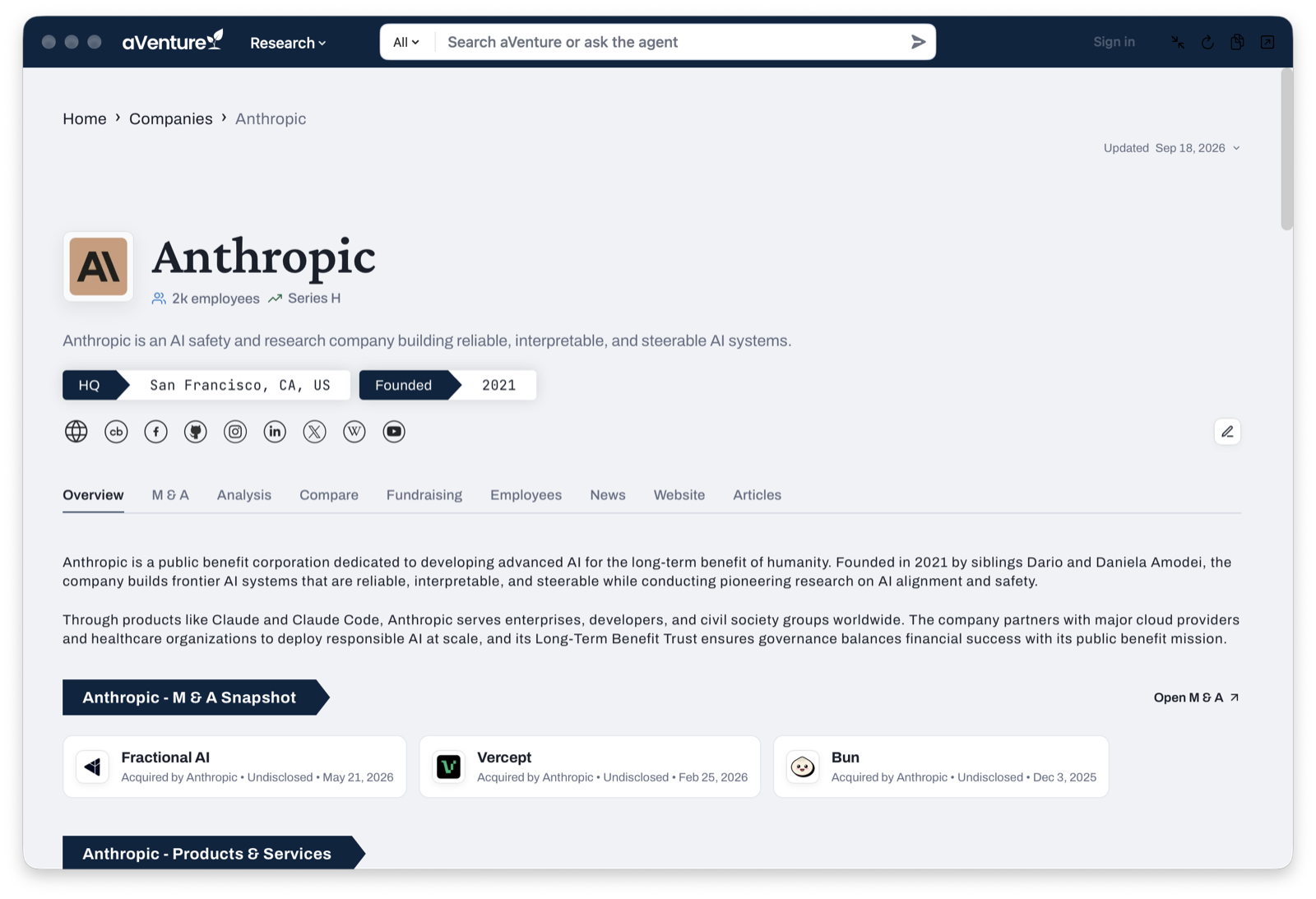
Company profiles like Anthropic's are the Public Research Data this policy distinguishes from User Data.
Serving The Public Interest, Without Trading Away User Privacy
Our most pressing concern as an organization is serving the public interest.
We view our public research data as a valuable public interest. And we think the public interest includes investors being able to research organizations and people so they can make informed decisions.
Investors need to be protected. One way we believe we can help provide that protection is by empowering them with valuable information, presented with context, so they can make informed decisions. That is not the same thing as claiming investors should be “tracked,” profiled, or exposed. It’s the opposite: we want to serve investors by offering clarity.
User data is different. User data is about a user or client’s relationship with aVenture: their account, their usage, and the data they create as part of that usage. Our aspiration is to align with the general principles of the CCPA (California Consumer Privacy Act), even though we are not yet subject to its regulations as an entity, because we believe in privacy rights for users.
Where These Two Categories Diverge
1) User Data: “Data you create as a user is yours”
In our intended direction:
- Any data you create as a user of aVenture’s platform is yours.
- You can delete it.
- You can obtain it by requesting us to do so.
2) Public Research Data: “Publicly knowable information should remain public”
Public research data is oriented toward informed decision-making in the public interest. Because of that, we plan to emphasize correctness:
- If something is public knowledge or information, or could be reasonably inferred under the mosaic theory of knowledge attainment, then our motivation and objectives will be to ensure that data is correct.
- Anyone can request updates to perceived or real inaccuracies: the subject organization or persons, a third party, or a platform user.
- If adequate evidence is provided (or is publicly available), we intend to update that information in the public research dataset.
This also means we will generally not honor requests for outright deletion of publicly knowable information, because we believe that would move against the public interest and the rights for investors to know about the companies they’re researching for decision-making.
Gray Areas We Expect To Encounter
We expect there will be gray areas that will require future reflection and consideration, especially when the lines blur between Public Research Data and User Data.
Additionally, aVenture may offer in the future a product that is free or subsidized by enriching the research dataset with data shared with the platform by users. A robust future data policy may require us to be able to ascertain what is publicly knowable vs. not privately knowable, and to distinguish the rights any person might have depending on where the data belongs.
That is part of why we’re publishing a draft: not to pretend we have every answer, but to ask the right questions early.
If you’d like to discuss this with the team, please reach out: https://aventure.vc/forms/contact