
Crunchbase is where most people first look up a startup. Crunchbase Pro, its individual-tier subscription, is the entry point to private-market data for sales teams, recruiters, and investors who need broad coverage without an enterprise contract. aVenture operates in the same territory — private company research at an individual-friendly price — with a different data model underneath.
As with all our comparisons, the Crunchbase facts here come from aVenture's own public research record on Crunchbase Pro, and our numbers come from the same database. Figures are as recorded at the time of writing.
What Crunchbase Pro is
Crunchbase Pro is the individual-tier subscription on the Crunchbase business-intelligence platform (Crunchbase, Inc., founded 2007, San Francisco). It unlocks unlimited search across more than four million private companies, growth signals, AI-powered insights, saved searches, alerts, and a 2,000-row monthly export quota. Subscribers query funding rounds, investors, acquisitions, key executives, and live financial data sourced from a community of more than 80 million contributors.
The product targets sales, business development, marketing, recruiting, and venture-investment professionals who need affordable, broad-coverage private-market data.
Where Crunchbase Pro is strong
- Breadth at an accessible price point. Four-million-plus company profiles make Crunchbase one of the category's broadest self-serve datasets.
- Community-scale inputs. A contributor community of more than 80 million people feeds updates that a closed research team would never catch.
- Prospecting workflow. Saved searches, alerts, and CSV exports fit sales and recruiting pipelines, which is where much of its user base lives.
Where aVenture takes a different approach
Crunchbase's breadth comes from community contribution; aVenture's depth comes from engineered research pipelines. aVenture tracks over 100,000 venture-backed startups aggregated from more than 1,200 sources, and the difference shows in how records are built:
- Canonical identity, deduplicated. Every company resolves to one profile; aliases, historical names, and every URL — website, LinkedIn, X, GitHub — are tracked against that single record and checked as current or historical. Duplicate checks run when new companies, products, or articles enter the graph, and GitHub repository analysis is coming soon on top of those tracked developer presences.
- Products and services as first-class records. Companies link to the actual products they sell, and competitors are joined product-to-product rather than by category tag — then rendered as side-by-side comparison tables.
- People with career timelines. Person profiles reconstruct role-by-role histories, each linked to the employer's profile, with similar-people discovery computed from profile content.
- Mentions, not just announcements. News and blog coverage is joined to the companies and products discussed, building a cumulative public record rather than a funding-event feed.
- Provenance everywhere. Every record carries its source and change history.
- Depth over breadth, stated plainly. Crunchbase's 4M+ universe includes older, bootstrapped, and non-US companies that aVenture covers more thinly today. Our depth advantage applies to the venture-backed core — significantly more linked, sourced detail per covered company — while coverage expands rapidly outward from it.
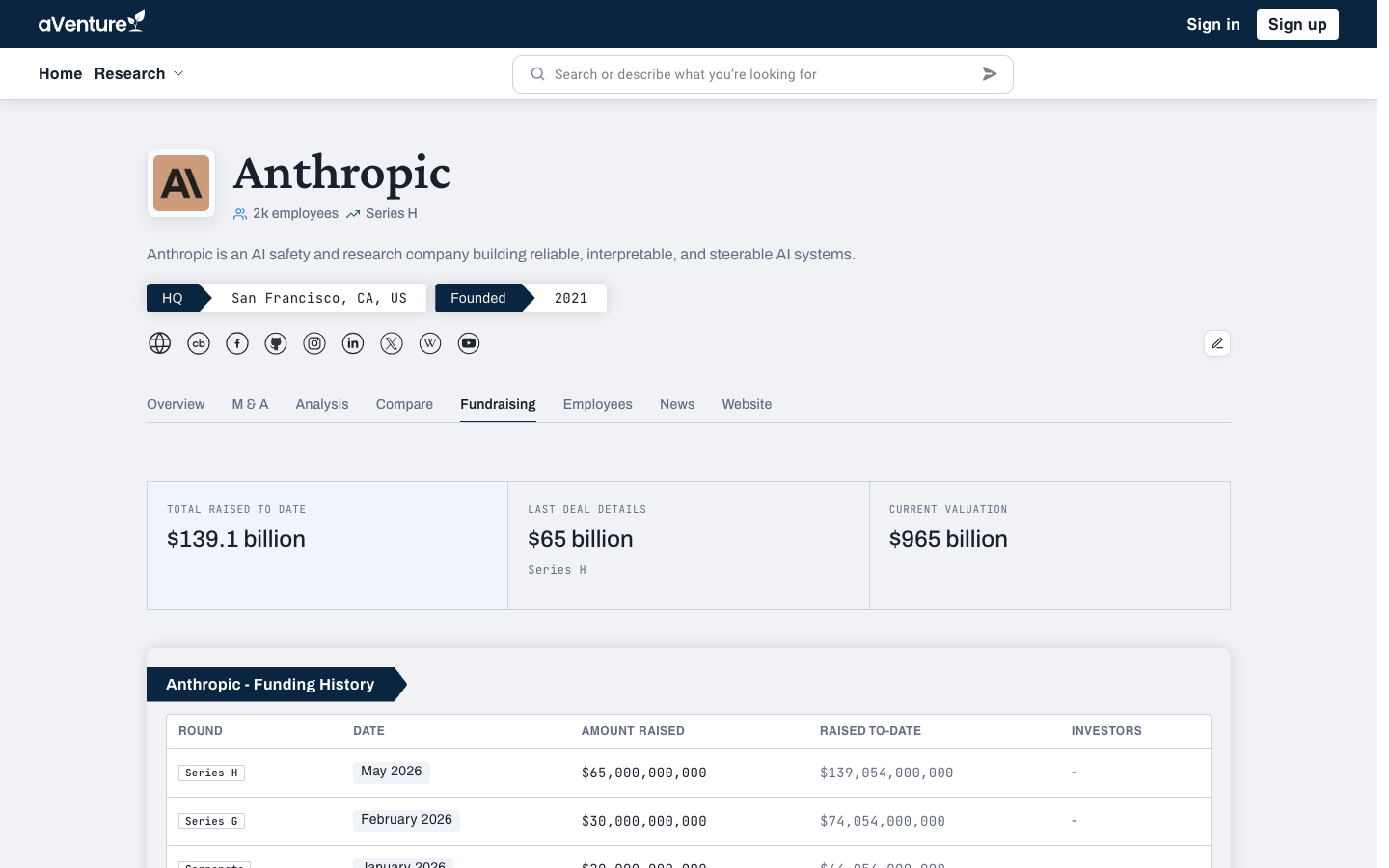
The Fundraising tab totals raised to date and lists each round with date and amount.
Feature comparison at a glance
- Coverage: Crunchbase Pro spans 4M+ companies of all kinds; aVenture focuses on 100,000+ venture-backed startups with deeper linked records.
- Data inputs: 80M+ community contributors (Crunchbase) vs. 1,200+ aggregated sources processed by research pipelines with provenance (aVenture).
- Competitive mapping: category- and signal-based similar companies (Crunchbase) vs. explicit product-to-product competitor joins with comparison tables (aVenture).
- Products/services: company-level records (Crunchbase) vs. product-level records linked to providers and competitors (aVenture).
- People: executive listings (Crunchbase) vs. full career timelines linked bidirectionally to companies (aVenture).
- News: funding-event driven (Crunchbase) vs. article-to-company-and-product mention joins (aVenture).
- Exports: 2,000 rows per month on Pro (Crunchbase); aVenture is a research application rather than an export quota.
Pricing
- Crunchbase Pro: paid subscription; current pricing is not recorded as a list price in our database — check the vendor.
- aVenture: See current aVenture plans and pricing.
Which one fits your workflow
Choose Crunchbase Pro if you need the widest possible net — prospecting lists, recruiting targets, or a quick check on any company that has ever raised — with alerts and exports built for volume.
Choose aVenture if you research venture-backed companies in depth: the linked graph of products, competitors, people, funding, and mentions turns a lookup into a research file. See current plans and pricing.
How we sourced this comparison
Competitor facts come from aVenture's public research record on Crunchbase Pro — including the competing-product relationship between the two platforms that our own graph maintains. We wrote this comparison with the feature it describes.