
PitchBook is the incumbent name in private capital market data. If you work in venture, private equity, or M&A, you have almost certainly used it — or been quoted a price for it. aVenture is a newer research platform built for the same underlying question — what is actually happening inside private companies and the capital around them — with a different architecture and a very different price point.
This comparison sticks to facts. The PitchBook details below come from aVenture's own research records on the PitchBook Platform product — the same public profile anyone can browse on our platform — and our own numbers come from the same database. Where we credit PitchBook, we mean it.
What PitchBook Platform is
PitchBook Platform is a subscription suite from PitchBook Data, Inc. (founded 2007, Seattle) that delivers private capital market data, research, and analytics across private equity, venture capital, and M&A. Subscribers query company profiles, deal histories, fund performance, investor activity, and limited-partner commitments, then export findings to Excel, build comparable tables, and run benchmarking against peer cohorts.
The platform layers proprietary models — PitchBook Valuation Estimates and the Morningstar PitchBook Private Market Indexes — on top of data sourced from public filings, regulatory disclosures, news, and a global research operation. Access is delivered through the web application, an Excel plugin, an API, and a Microsoft Word integration.
Where PitchBook is strong
- Fund and LP data. Fund performance, investor activity, and limited-partner commitments are core PitchBook strengths. If your work is fundraising benchmarks or LP coverage, this is the deepest part of the product.
- Institutional workflow integrations. The Excel plugin, Word integration, and API are built for analysts who live in Office and need exportable comps.
- Established research operation. A global human research team, plus proprietary valuation estimates and the Morningstar index family, back the dataset.
Its customer base — private fund managers, investment banks, corporate development teams, law firms, and academic researchers — reflects that institutional center of gravity.
Where aVenture takes a different approach
aVenture Research Platform tracks over 100,000 venture-backed startups worldwide, aggregating data from more than 1,200 sources into a single research graph. The design center is the company record itself, and everything connected to it:
- One linked graph, not siloed modules. Companies, investment firms, funds, products and services, and people resolve to canonical profiles that link to each other — a founder's career timeline links to every employer's profile; a fund links to its rounds and portfolio.
- Product-level competitive mapping. Competitors are joined product-to-product, not guessed from category labels, and rendered as side-by-side comparison tables. This very article is built on those joins.
- Mention tracking joined to companies and their products. News and articles link to the specific companies and products they discuss, so a company's public record accumulates in one place.
- Website structure analysis. aVenture's research pipelines crawl and classify company websites, turning site structure into positioning evidence; a per-company index of ingested articles and crawled pages is coming soon to profiles.
- Provenance on every record. Each claim carries its source — where the data came from and when it changed.
- An honest coverage note. aVenture's depth today concentrates on current venture-backed, primarily US companies; older companies, non-venture-backed businesses, and non-US markets are covered more thinly while the dataset builds out rapidly. PitchBook's multi-decade deal and fund history remains broader on those dimensions.
The pipelines behind this are agent-scaled rather than headcount-scaled: research agents gather evidence from the public web, classify it, attach sources, and keep records current.
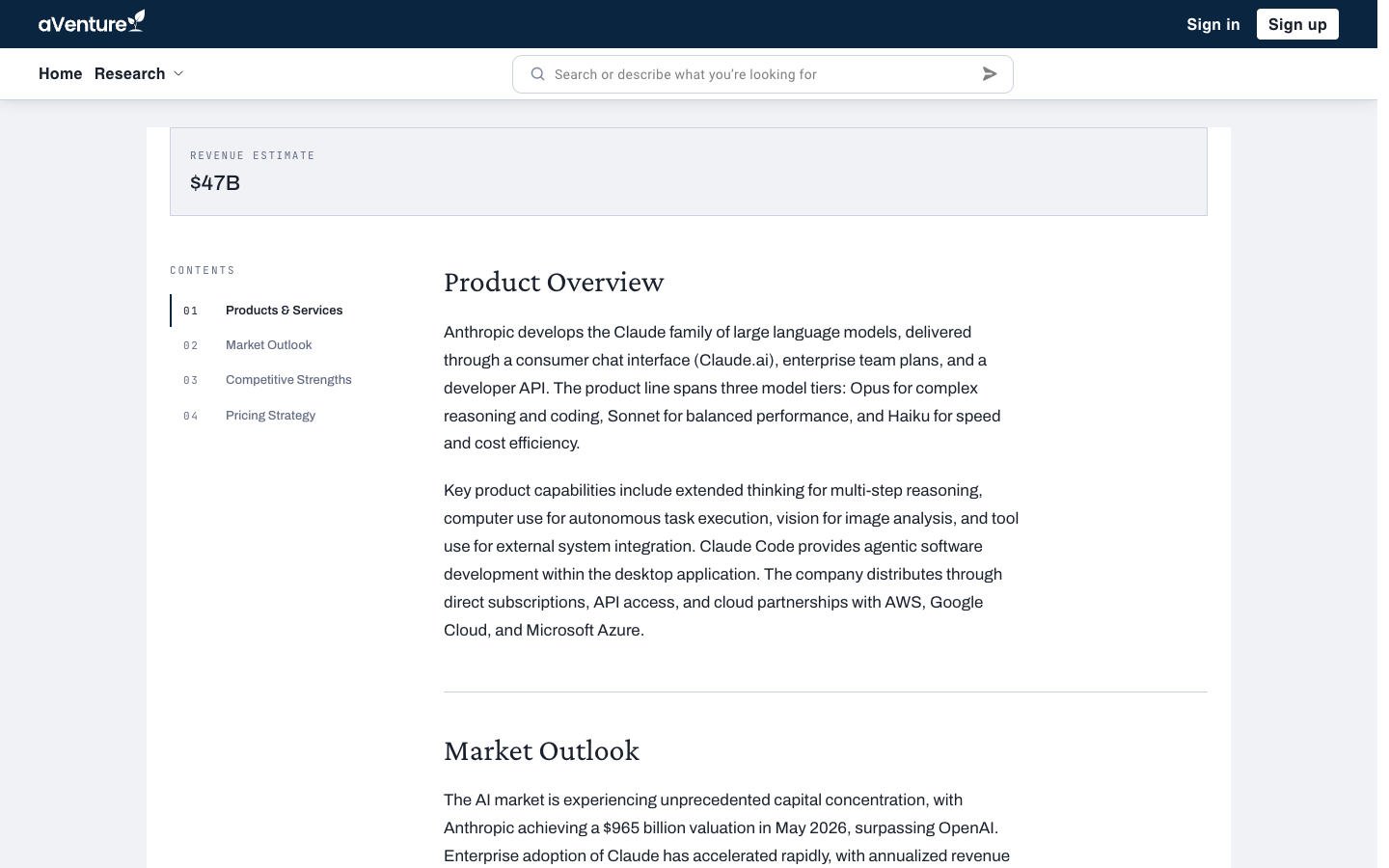
The Analysis tab memo view on Anthropic's company profile.
Feature comparison at a glance
| Dimension | aVenture Research Platform | PitchBook Platform |
|---|---|---|
| Core focus | Venture-backed startup research | Private capital markets (PE, VC, M&A) |
| Coverage | 100,000+ venture-backed startups, 1,200+ sources | Companies, deals, funds, investors, LPs |
| Fund performance & LP data | Fundraise rounds and investor participation | Deep fund performance and LP commitments |
| Competitive mapping | Product-to-product competitor joins with comparison tables | Comparable tables built by the analyst |
| News & mentions | Articles joined to companies and products | News as a data source |
| Website analysis | Site crawling and page classification | Not a product focus |
| Data provenance | Source recorded on every record | Global research operation |
| Delivery | Web application | Web, Excel plugin, API, Word |
Pricing
Figures as recorded in our research database at the time of writing; confirm current pricing with each vendor.
- PitchBook Platform is an enterprise subscription; pricing is quote-based and generally not published.
- aVenture: See current aVenture plans and pricing.
Which one fits your workflow
Choose PitchBook if your daily work is fund performance analysis, LP coverage, or building exportable deal comps inside Excel — that is the institutional workflow it was built and priced for.
Choose aVenture if your work is researching venture-backed companies themselves: who builds what, who competes with whom at the product level, who funded them, who runs them, and what the public record says — with sources attached and without an enterprise contract.
How we sourced this comparison
Every competitor fact above comes from aVenture's public research records — the same competing products relationships and product profiles any user can browse on the platform. That is the point: we used our own competitive-mapping feature to write this article.