
Public companies come with filings, disclosures, and armies of analysts. Private companies come with a marketing site, scattered press mentions, and whatever the founders chose to share. If you have ever wondered how to research private companies rigorously — not just skim a funding announcement and move on — the honest answer is that it takes a workflow, not a single lookup.
We are building aVenture around that workflow. This guide walks through the steps we think serious private company research requires, why each one is harder than it looks, and how we are engineering a research platform so the work compounds instead of starting from zero every time.
Why private company research is hard
The problem is not that information about private companies doesn't exist. It's that the information is fragmented, unlabeled, and frequently wrong in quiet ways:
- The same company appears under different names, old brands, and lookalike domains.
- Funding details are announced once, then never corrected when terms change.
- Team pages go stale. People leave and their bios linger for years.
- "Competitors" lists are usually someone's guess, not an observation of the market.
Traditional private-market databases solve part of this with human data operations: analysts collect, enter, and update records. That model produces broad coverage, but depth is expensive, and freshness depends on how recently a human touched the record. Our approach is different — agent-scaled research pipelines that gather evidence from the public web, classify it, attach sources, and keep the record current — with every claim traceable to where it came from.
Whichever tools you use, the workflow below is the same.
Step 1: Resolve the company's identity
Before anything else, establish that you are researching the right legal and operating entity. This sounds trivial. It isn't.
Startups rename themselves, spin out subsidiaries, operate under DBAs, and share names with unrelated businesses in other markets. A diligence file that silently mixes two companies with the same name is worse than no file at all.

A name search returns several lookalike companies; resolving the right entity is step one.
A canonical company profile should pin down the official name and aliases, the primary website and domain, headquarters and office locations, founding year, and the company's current operating status. On aVenture, every company resolves to one canonical profile, and every alias, historical name, and related URL — including social and developer presences like LinkedIn, X, and GitHub — is tracked against that single record, with each URL checked and marked as current or historical.
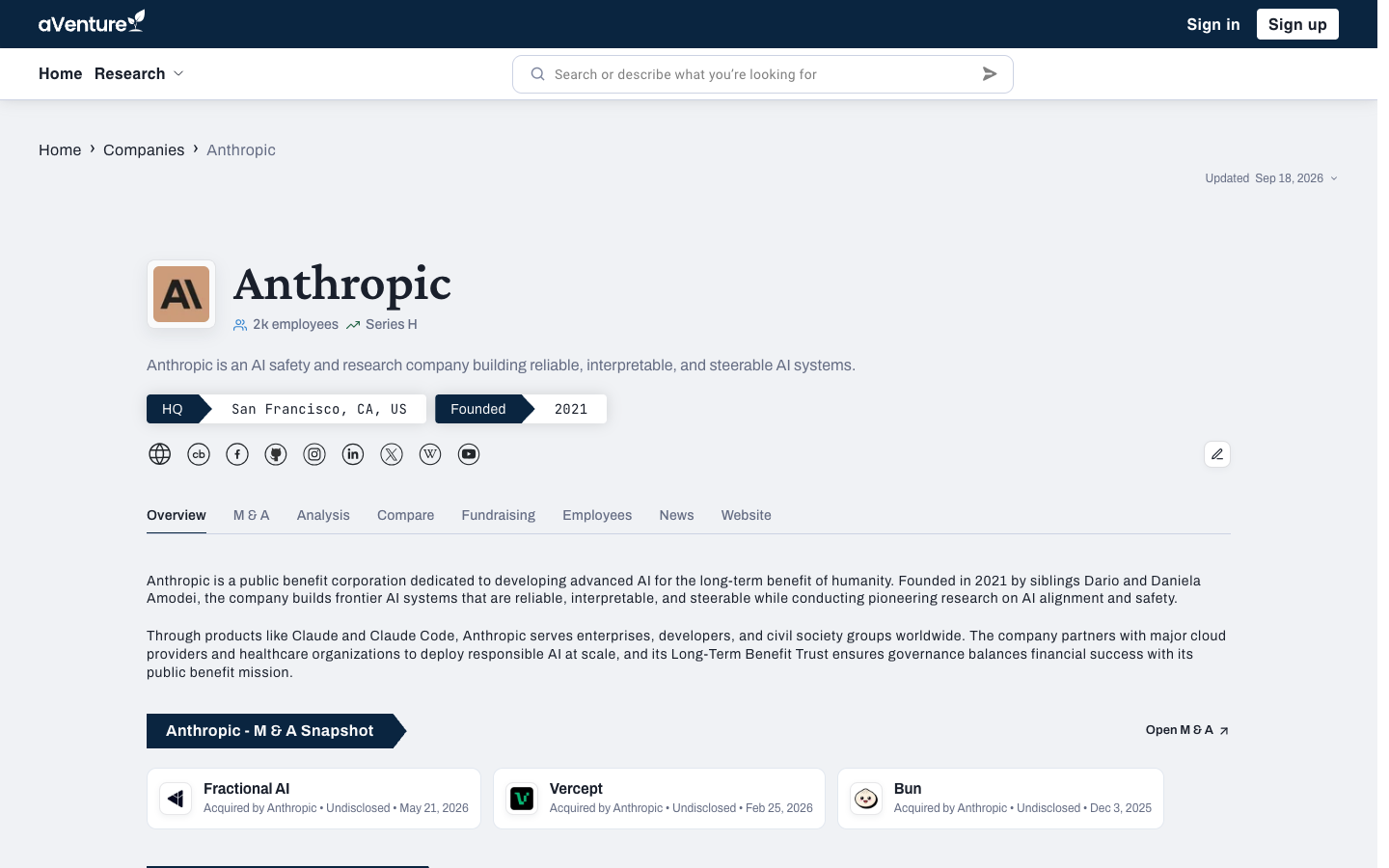
The engineering matters here: identity resolution is a deduplication problem. Our pipelines run duplicate checks when new companies, products, or articles enter the graph, so two records that describe the same real-world thing get caught and merged rather than drifting apart.
Step 2: Research the founders and team
A private company is, early on, mostly its people. Founder and team research answers questions a pitch deck won't: What did these people actually do before? How long did they stay? What did they build together?
Useful people research means reconstructing a career timeline — roles, employers, and tenures in order — rather than reading a self-written bio. On aVenture, person profiles present a career history as a single timeline: each role linked to the employer's company profile, with tenure, title, and current-role status. From there you can traverse outward: who else worked at those companies, which investors backed them, and which similar people occupy comparable roles in the market — a similarity we compute from profile content itself, not from manually curated lists.
The point of linking people to companies bidirectionally is that diligence questions run in both directions. "Who founded this company?" and "what else has this founder started?" should be the same data, viewed from two sides.
Step 3: Reconstruct the funding and investor history
Funding history is where private company research most often goes wrong, because announcements are noisy: rounds get reported multiple times, amounts differ between outlets, and extensions blur into new rounds.
A defensible funding picture includes each round with its date and amount, the investors participating in it, total capital raised over time, and program participation such as accelerators. On aVenture, a company's fundraising view shows rounds, investors, and capital-raised history, and each investing firm and fund has its own profile — so you can pivot from "who funded this company" to "what else does this fund hold" without leaving the graph.
Because every funding fact carries its sources, you can see why the record says what it says — which article, filing, or first-party page supports the number — instead of trusting a bare figure.
Step 4: Understand the market and the product
"What does this company actually sell, and to whom?" is the question that separates real research from pattern-matching on a category label.
We model products and services as first-class records: each offering a company provides is identified, described, and linked to the company that provides it. The same pipeline then maps competing products and services — offerings from other companies that contest the same buyer — which is how a competitive landscape gets built from observed products rather than from a static industry code.
That structure enables comparison you can defend. aVenture's compare view benchmarks a company against its actual peers — companies whose products compete with its products — and a similar-firms view does the equivalent for investors. We are also expanding how we read a company's own self-presentation: our crawler maps a company's full website — its pages, sections, and structure — and classifies what it finds (pricing pages, product pages, careers, documentation), including sites that only render with JavaScript. A dedicated Website view on company profiles built on that map is coming soon.
Step 5: Read the traction and momentum signals
Private companies don't report quarterly numbers, so traction has to be read from external evidence: news coverage, hiring, partnerships, product launches, and how often the company shows up in other people's writing.
Doing this at scale is an ingestion and matching problem. Our pipelines continuously ingest news and RSS feeds, then match each article to the specific companies and people it mentions — using both deterministic signals and language-model classification with confidence scoring, so a story about "Apollo" attaches to the right Apollo. Beyond mainstream news, we index research and blog writing — company engineering blogs, founders' personal blogs, newsletters — and track which other companies and people each article mentions, with machine-generated summaries so you can triage quickly.
On a company profile, this surfaces as a news view of the coverage that actually concerns that company. Mentions are a two-way signal: a company that is frequently referenced in others' writing is telling you something different from one that only publishes about itself.
Step 6: Look for the risk and diligence signals
Good research also asks what's wrong. The signals worth checking before you rely on a record:
- Operating status. Is the company still operating, acquired, or quietly dissolved? Status should be an explicit field, not an inference from a live website.
- Source quality and disputes. Where did each fact come from — a first-party page, a news article, a form submission? Has anyone disputed it? Our provenance model records the source type, the actor that wrote the fact (including which automated agent and model, when one did), the timestamp, and a confirmation status that can mark a fact as disputed.
- Staleness. When was the record last touched, and by what? Every profile carries its update history, so "current as of when?" has an answer.
This is the part of the platform we consider least optional. Research you can't audit is research you eventually have to redo.
How to research private companies without losing the thread
The final step is organizational: keeping what you learned connected. Notes in a document decay; a knowledge graph compounds. When companies, people, investors, funds, products, news, and articles are all typed records connected by explicit relationships, every answer you find becomes a path to the next question — and every researched company improves the map for the next one.
That is the core design decision behind aVenture: not a directory of company pages, but a graph where the sixth step of one investigation is the first step of another. The workflow above isn't software-specific — you can run it manually with a browser and patience. Our goal is to make the rigorous version of it the fast version.
Try the research preview
We haven't commercially launched yet; we're building this in the open and want it shaped by the people who do this work. If you research private companies — as an investor, a strategist, an operator, or a founder sizing up your own market — you can join the free research preview waitlist at aventure.vc/free-research, or tell us what your diligence workflow needs at aventure.vc/forms/contact.