
A private company's public record is scattered. A funding announcement lands in a trade publication. A founder writes a personal blog post about a pivot. A partner mentions the company in a podcast recap. An engineering blog quietly names the customers it built something for. Each piece is public; almost none of it is in one place. The ability to track company mentions — reliably, across every kind of source, over years — is what separates research from recollection.
We've been building this into aVenture from the start, because mentions are where the real texture of a company lives. Databases record what a company is: its name, its location, its funding rounds. Mentions record what a company is doing, what others say about it, and who it's connected to. That second layer is far messier — and far more valuable when it's organized.
Why mentions are the hardest data to keep
The problem isn't finding articles. Search engines find articles. The problem is everything after:
- Knowing who an article is actually about. "Mercury" is a bank, a planet, an element, and at least a dozen startups. Matching an article to the right company — not a similarly named one — is the core difficulty of company news monitoring.
- Knowing when two articles are the same story. The same announcement gets syndicated, rewritten, and aggregated. Without deduplication, one event looks like ten.
- Knowing the difference between the author and the subject. A founder's blog post belongs to that founder — but it may mention three other companies and two other people. Those are different relationships, and conflating them corrupts both.
- Keeping it going. A one-time sweep is a snapshot. Mentions only become a research asset when collection runs continuously and the record accumulates.
Most teams solve this with a shared spreadsheet and good intentions. It decays within a quarter.
Three paths into one record
Our approach is to treat mentions as structured data with three distinct ingestion paths, each built for a different kind of source, all landing in one connected record.
1. News, matched to the companies and people it covers
News articles enter the platform and are matched to the companies and people they cover using AI-assisted entity matching. The matching is deliberately skeptical: names are ambiguous, and a wrong link is worse than a missing one, so matches carry confidence and ambiguous cases are treated as unresolved rather than guessed. Duplicate detection runs alongside — when the same story arrives from multiple outlets or the same outlet twice, it's recognized as one story rather than inflating a company's apparent coverage.
The result is that a company's profile carries its actual press record: what was written, when, and where — attached to the company itself rather than floating in a search index.
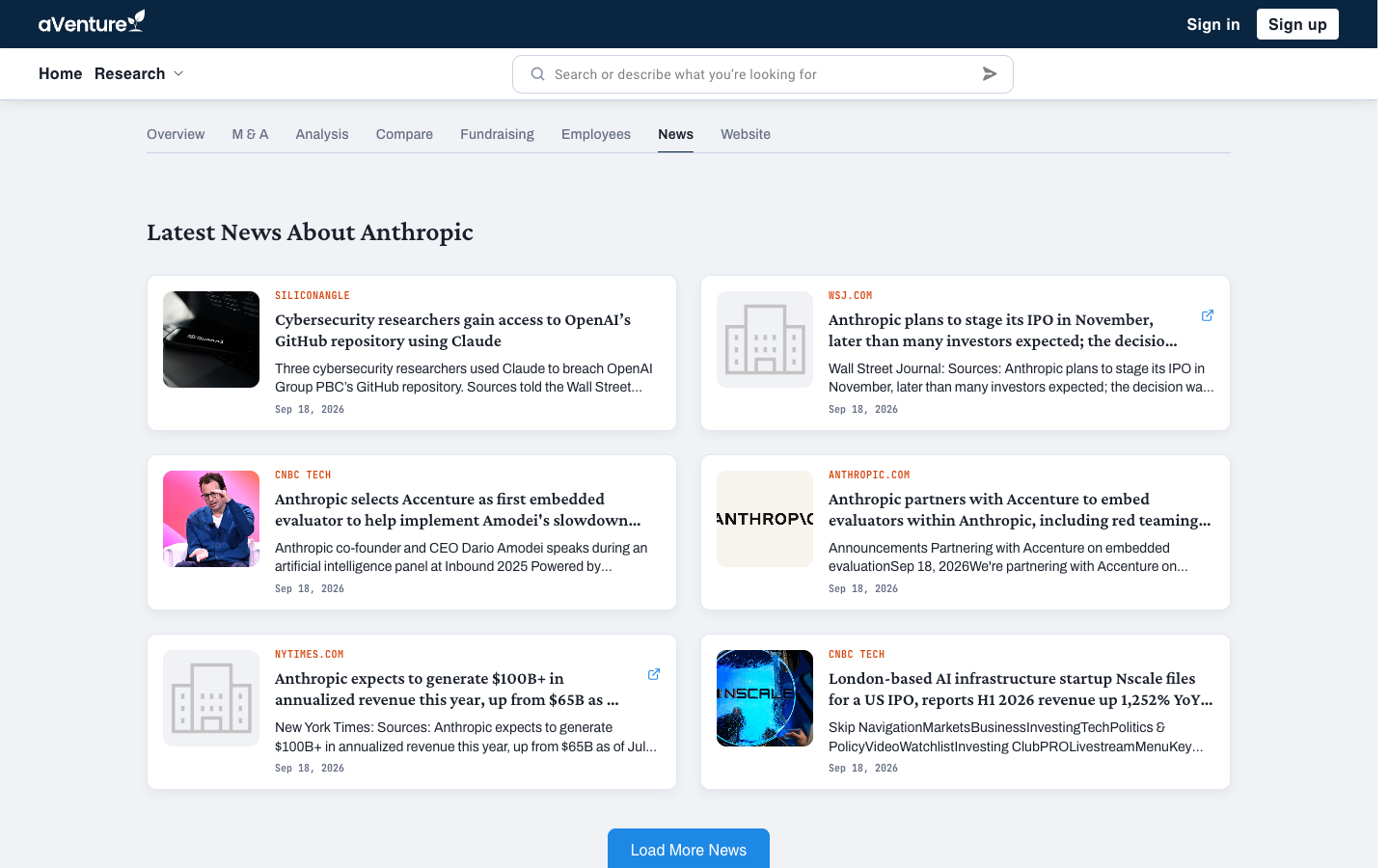
The News tab: Anthropic's accumulated press record, attributed and dated, on its profile.
2. Feeds, ingested automatically
Publications, aggregators, and company newsrooms publish structured feeds, and we ingest them continuously. Each feed item is parsed, the companies and people it mentions are linked, and duplicates are coalesced — both within a single feed and across sources reporting the same item. This is the always-on layer of startup news tracking: it doesn't depend on anyone remembering to check, and it keeps the record current between deliberate research sessions.
3. Blogs and research writing, attached to their owners
The third path covers the writing that traditional media monitoring for startups misses entirely: company engineering blogs, founders' personal blogs, professional posts, and research writing. These get attached to the company or person they belong to — a founder's essay lives on that founder's profile; a company's announcement lives on the company's.
Each article also gets an AI-generated summary, so a profile with years of accumulated writing can be scanned in minutes rather than re-read from scratch.
The mention graph: who else appears in the story
Here is the part we think matters most, and the part that requires the most care: for every article, we record not just who it belongs to, but which other companies and people it mentions.
The distinction sounds small. It isn't.
When a founder writes "we built our integration on top of Company X, after evaluating Company Y," that post is owned by the founder — and it mentions two other companies. Those mentions are evidence: of a customer relationship, of a competitive evaluation, of an ecosystem position. If your tracking system can't represent "mentioned in, but not about," this evidence either disappears or — worse — pollutes the record by wrongly attaching the article to companies it merely names.
Because we store mentions explicitly, the question can be inverted. Instead of only asking "what has this company published?", you can ask "which articles, anywhere in the corpus, mention this company?" — and get back the trade coverage, the third-party blog posts, the founder essays, and the research write-ups where the company appears in someone else's story. For private company research, that inverted question is often the more revealing one. Companies control what they publish. They don't control where they're mentioned.
The engineering underneath
We try to be candid that the value here comes from unglamorous correctness work, not from any single clever feature.
Entity matching has to earn trust. Every automated link between an article and a company is a claim, and wrong claims compound — one bad match puts a company's name on someone else's news forever. So matching decisions carry confidence, conservative thresholds, and provenance: what was matched, on what evidence, and when.
Deduplication has to work across sources, not just within them. The same story arrives at different times, from different feeds, with different headlines. Coalescing those into one event — while keeping the record of everywhere it appeared — is what keeps a company's timeline honest.
Ownership and mention are separate facts. As described above, we model "this article belongs to X" and "this article mentions Y" as different relationships, and we keep an article's owner out of its own mention list. It's a small rule that prevents a large class of quiet data corruption.
Similarity is a tool, not a substitute. We compute content embeddings over articles so that related coverage can be found even when names and keywords differ. But similarity suggests; it doesn't decide. Links between articles and entities are made by the matching process, not by proximity in an embedding space.
Where you see this today — and what's next
On aVenture company profiles today, matched news appears directly on the company's page, and a person's writing appears on their profile as a compact, scannable record alongside their career history. The mention data accumulates underneath, connecting articles to every company and person they reference.
Coming soon: a searchable Articles index on each company profile — the full accumulated record of articles by and about a company, filterable and organized by topic and time, including the pieces that only mention it. The data layer for this is built and accumulating; the browsing experience is what's on the way.
The record should already exist when you need it
The moment you need a company's complete public record — before a meeting, a term sheet, a partnership — is exactly the moment it's too late to start collecting it. Continuous, structured mention tracking means the record is already there, already deduplicated, already attached to the right companies and people, with every claim traceable to its source.
aVenture hasn't commercially launched yet. We're inviting investors, researchers, and operators to try the research preview early and push on it. Join the waitlist at https://aventure.vc/free-research.