
Private company research is still slow, shallow, and manually stitched together. An analyst opens a dozen tabs, reads a company's site, skims the news, checks a funding announcement against a secondhand summary, and pastes fragments into a document that goes stale the moment it's saved. The tooling has improved around the edges, but the underlying model — a human manually assembling evidence into notes — has barely changed.
We think AI agents for research change that model fundamentally, and not in the way most "AI features" do. When we started building aVenture, we made a decision that shaped everything after it: we would not build a database with an AI layer sprinkled on top. We would build an agent-powered research system — one where AI agents do the research themselves, under rules strict enough that their output is worth trusting.
This post explains what that means concretely, and some of the engineering it took to make it real.
A research run, not a data import
Traditional private-market databases and manual data operations share a common shape: data arrives in bulk — licensed feeds, form submissions, periodic human updates — and gets loaded into records. The unit of work is the import.
Our unit of work is the research run. An agent is assigned a question about a company, and it goes and answers it the way a researcher would:
- Discovering what a company actually offers. Agents research a company's products and services — not just its category tag — and record each offering as its own entity in the graph.
- Mapping the competitive landscape. For a given product or service, agents identify competing offerings from other companies and record those competitive relationships explicitly, so a market map is derived from researched edges rather than a shared industry label.
- Crawling and mapping websites. Agents and crawl pipelines map a company's own website — its pages, sections, and structure — because what a company says about itself, and how its site is organized, is primary-source evidence about its positioning.
- Linking mentions across news and blogs. Ingest pipelines watch news and blog feeds, and agents match articles to the companies and people they actually mention, so a profile accumulates its media footprint over time.
The output of each run isn't a paragraph in a document. It's structured updates to a knowledge graph of companies, people, investors, funds, accelerators, funding events, products, and the relationships between them — every claim attached to its evidence.
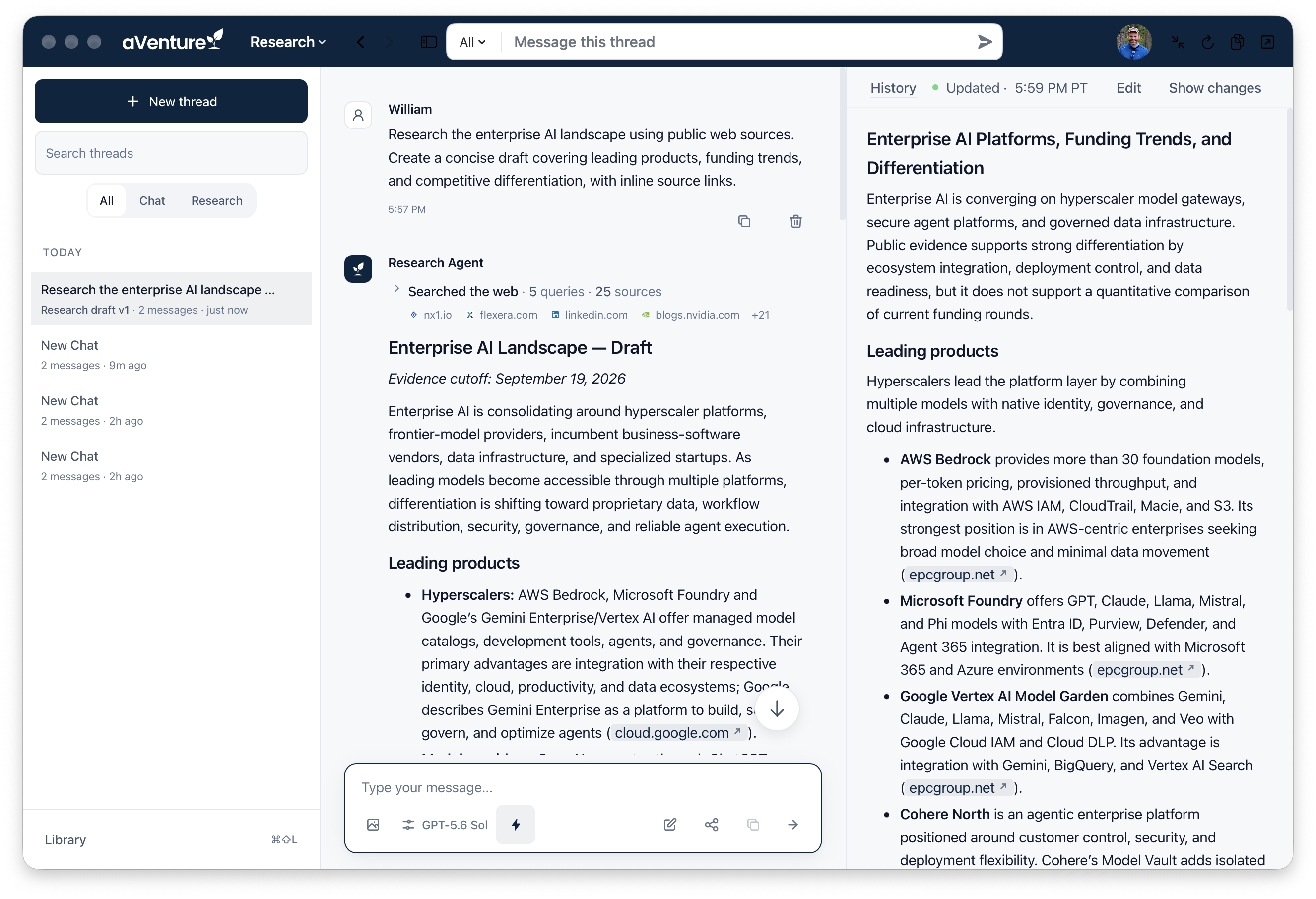
An enterprise AI research run: five web queries, 25 sources, and an editable cited draft.
That's the substance behind a phrase we use internally: research should produce source-backed claims, not trapped prose.
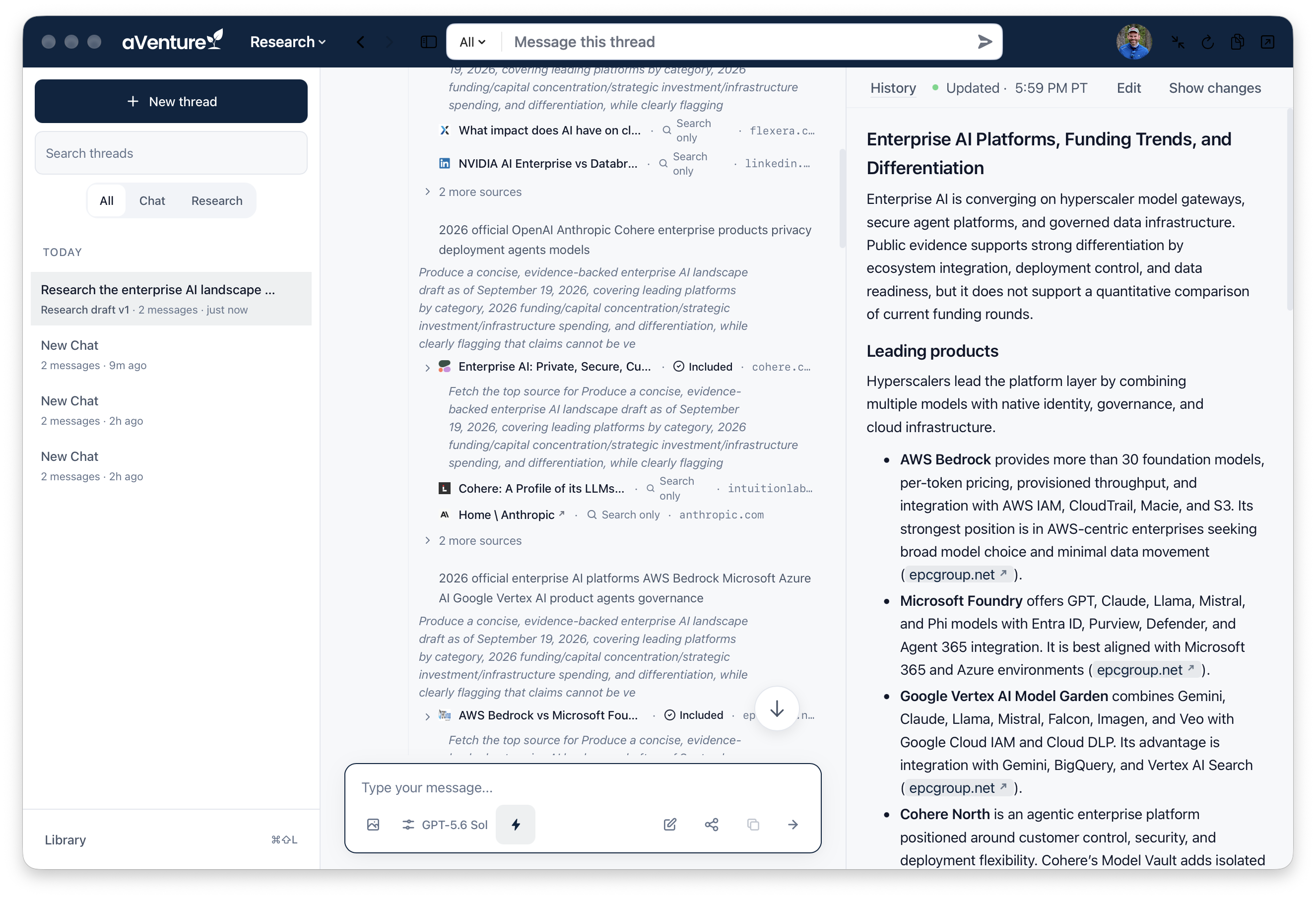
Expanded web sources from the completed enterprise AI research run.
The rules that make agent output trustworthy
The obvious objection to agent-scaled research is the right one: AI systems can be confidently wrong. We don't dispute that — we designed for it. Agents on our platform don't get free-form write access to anything. They work inside a set of constraints that took us longer to build than the agents themselves.
Every write is validated at the door
Each kind of research fact has a validation contract enforced at write time: allowed values, numeric ranges, required structure — even the shape of narrative text is checked before it's accepted. An agent that produces a malformed or out-of-contract result doesn't degrade the graph; its write is rejected. The graph's integrity doesn't depend on the agent having a good day.
Every write is attributed
Every fact records the actor that wrote it — and when that actor is an agent, the specific model is recorded too, alongside the source evidence it relied on. If a claim is ever questioned, we can answer which agent, which model, based on what, and when. We think this kind of accountability is the minimum standard for machine-assisted research, and it's remarkable how rarely it exists.
Duplicates get hunted, not accumulated
Research at scale produces overlap: two runs can surface the same product under slightly different names, or the same article from two feeds. Dedicated sweep jobs continuously check for duplicate entities and duplicate articles and resolve them, so scale doesn't quietly turn into noise.
Pipelines are budgeted, not unbounded
Agent research runs, crawls, and ingest jobs execute as asynchronous pipelines with explicit concurrency budgets. That's less glamorous than the agents themselves, but it's what makes "run this research across many companies" an ordinary operation instead of an outage — the system decides how much parallel work the infrastructure can afford and queues the rest.
Humans and agents use the same doors
One design decision we'd defend anywhere: there is no privileged back channel for agents and no separate, laxer path for humans. Human researchers and AI agents work through the same governed interfaces, with the same validation and the same provenance requirements.
That principle extends outward, too. Alongside the web platform, aVenture has a command-line research tool for fast, repeatable research workflows — and an MCP server, an agent-native interface that lets AI agents search, inspect, enrich, and organize company intelligence directly. If you're building with agents yourself, the same structured, source-backed graph our agents maintain is something your agents can query on equal footing.
We built it this way because we think the near future of research is mixed teams — people and agents working the same corpus — and a system that treats those as separate worlds will fracture into inconsistency.
Depth first, scale second
Our stated design goal from the beginning has been depth first and scale second. That ordering is deliberate.
Going deep on one company — its real product line, its actual competitors, its site structure, its media footprint, its people and funding history, all with sources attached — is the hard problem. Doing it shallowly for a million companies is easy and, we'd argue, not very useful. So we built the machinery to do the deep version correctly: the contracts, the provenance, the dedup sweeps, the budgeted pipelines. Scale then becomes a matter of running that machinery more, not compromising it.
There's a compounding effect we're explicitly designing for: every researched company improves the graph. A newly mapped competitor relationship enriches two companies at once. A newly linked article adds context to every company and person it mentions. A crawled site sharpens the picture of a market's positioning language. We describe this as building a compounding data asset — that's our intent and our architecture, and we'd rather state it as a goal we're engineering toward than dress it up as a measured result.
For the same reason, we won't claim our agents "match human analysts." What we will claim, because it's how the system is built, is narrower and more useful: every fact an agent contributes is validated, attributed, sourced, and auditable — which is more than can be said for most numbers a human copies into a spreadsheet.
What's live and what's next
The research system described here — agent research runs over products, services, and competitors; website crawling and mapping; news and blog mention linking; the knowledge graph; provenance and validation on every write — is the working core of the platform today. Some of the ways we'll surface that research in the product, like dedicated website-map and article-index views on company profiles, are coming soon.
We haven't commercially launched yet. We're building carefully and in the open, because a research system earns trust the same way a researcher does: by showing its work.
If you want to research private companies with a system built this way — or point your own agents at one — we'd like to have you in early.
Join the research preview waitlist at aventure.vc/free-research.